Category: Athens

Fall Mts

October 2026 Curated Climate News

OCTOBER 2026

Every month, we scour the headlines to curate a mix of news that helps us understand how climate change is impacting our lives and recognize the solutions we have to address the risks. Here are some highlights from the past few weeks:

Georgia News of Hope

Georgia’s two new Public Service Commissioners promise to lower power bills using clean energy and to hold data centers accountable. The new commissioners say they hope to  fulfill Southern Company’s goal of net zero emissions by 2050.

The University of Georgia plans to use an $8 million federal grant to restore marshes that are eroding due to climate change-driven sea level rise in Georgia, Florida, and the Carolinas. Salt marshes provide critical wildlife habitat and protect against the dangerous tides and flooding brought by stronger storms. 

Athens-Clarke County is making measurable progress toward its goal of 100% clean and renewable electricity for municipal properties and government operations by 2035. Officials estimate the county is now 45% to 60% of the way toward the 2035 target.

At the Athens-Clarke County Landfill, dozens of wells drilled into buried waste capture methane produced by decomposing organic material and pipe it to an on-site plant, where it is converted into usable electricity. This gas-capture system mitigates the climate impact of waste already buried at the site. 

Athens Area Habitat for Humanity recently celebrated a solar panel installation at Micah’s Creek, a new affordable housing development. The Bright Homes Energy Initiative, the volunteer group spearheading solarization, seeks to reduce dependence on fossil fuels and create a neighborhood with some of the lowest utility bills in the state. 

Congregation Children of Israel in Athens recently upgraded its facilities with a new rooftop solar array that will help the congregation lower its monthly electricity costs and generate its own clean power.

Georgia News of Concern

Georgia’s data centers are using diesel backup generators that emit nitric oxide in quantities that more than double Georgia Power’s two large coal plants. State lawmakers are urging the EPA to regulate these emissions, which drive climate change and are harmful to the health of nearby communities.

Georgia extended its annual wild oyster harvest closure date beyond the usual September 30. Unusually warm ocean temperatures have allowed bacteria to flourish, making oysters unsafe to eat. 

Ways to Act

Georgia college students are asking for 15 minutes of your time. Please watch their short videos about the climate crisis and what we can all do about it. 

A podcast episode we think you’ll like: “Whatever Happened to the Ozone Hole?” from Are We Doomed?

Remember the hole in the ozone layer? Today, it’s largely considered one of our biggest environmental success stories – but getting there was much messier than we remember.

 This episode of Are We Doomed? goes back to how scientists discovered the problem, the political and public battles over what to do about it, and how the world ultimately came together to take action. For Simmer Down listeners, it’s a fascinating and hopeful look at what it actually takes to build consensus around a global environmental threat, and what that success might teach us about tackling climate change today.

The Big Picture

News of Concern

■  The Trump administration plans to roll back regulations requiring oil and gas companies to detect and repair methane leaks. Methane is one of the most potent greenhouse gases and cutting back leaks is considered one of the fastest ways to slow warming. 
■  Most of our coral reefs – vital ecosystems for the whole planet – could collapse in the next 50 years if climate change continues on its current trajectory. 
■  California, which is responsible for almost 15% of our national GDP, issued a new climate assessment report that projects a difficult future: more wildfires, bigger storms, longer droughts, vastly reduced beaches and snowpacks, and significant hits to farming and property values. 
■  Texas A&M’s university system removed climate change from core curricula at public universities because it has deemed it not “foundational and fundamental” to prepare students for civic life and the workforce, even though since 1980, Texas has experienced the most weather-disaster damages of any state and is considered one of the most vulnerable states going forward.   

News of Hope

■   Experts see signs that the U.S. electric vehicle market is rebounding as automakers roll out better and cheaper models and gas prices remain high.

■   Ford’s Fathom – an electric pickup due to hit markets in 2027 – doesn’t just have a low sticker price, it has technology that will allow it to act as a home battery, a real advantage as grids become more insecure.

■   Thermal storage – battery arrays that store “blistering” heat and release steam as a power source – has the potential to provide vast amounts of inexpensive clean energy.

■   A new report shows using more heat pumps to warm and cool our homes could help significantly drive down electricity costs, save emissions, and smooth out grid use in most parts of the country.

Notable Graphic

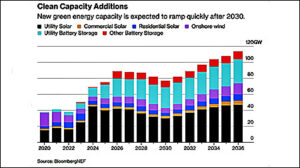
The U.S. is still installing record amounts of clean energy, with growth expected to accelerate next year and surpass natural gas capacity by September of 2027. At the same time, however, the data center surge is driving an expansion of natural gas, dampening the climate benefits from that clean-energy growth.

Notable Video

Electrify everything! It’s our climate change mantra, and it’s happening all around us. For example, electric ferries are increasingly sailing (and, in some cases, “flying”) across the water, allowing us to travel in an affordable, clean way – and a fun one, at that. This video from Climate Central gives us a great peek into this growing mode of transportation.

Read More
AI Blog 250

AI and Climate Change – A Blog by Kathleen Biggins

Worrying about Climate and AI
Isn’t Crazy. It’s Smart.


By Katheen Biggins

The White House recently suggested that the same “hysterical” people who care about climate change are the ones concerned about the rapid buildout of artificial intelligence. The administration might be onto something.

Not because the AI buildout is driving up emissions – although that is a growing concern. One recent report estimates that the increase in U.S. emissions associated with gas-powered AI and data centers over the next three years could equal Mexico’s entire current annual emissions. Nor is it simply because AI infrastructure can create environmental problems, including air, heat, and noise pollution.

And certainly not because those of us concerned about both issues are simply “Luddites” who shun all technological progress.

It is because climate change and AI share some striking similarities that may not be apparent at first glance.

Climate change is primarily driven by carbon pollution from burning fossil fuels. These fuels have powered the development of our modern world, bringing prosperity and a high quality of life to billions of people. But the very technology that helped build our civilization is now destabilizing the natural systems on which we depend. We are setting in motion changes that, once unleashed, could be impossible to reverse within human timescales.

We have known for decades that burning fossil fuels would harm our planet. President Lyndon B. Johnson was briefed on the dangers of rising carbon dioxide levels in the 1960s. Yet we failed to develop the policies and technologies needed to safely manage our dependence on fossil fuels. Had we acted earlier, we could have avoided much of the damage we are now facing.

The short-term benefits were simply too seductive. Fossil fuels created enormous wealth and prosperity, while the consequences of their use seemed distant and abstract. But now the bill is coming due.

Climate change is already imposing substantial economic costs, from destructive storms and wildfires to rising insurance premiums and damage to infrastructure. The projected losses are staggering. Experts warn that climate-driven insurance costs could make homes, businesses, and long-term investments increasingly difficult to insure at affordable rates. This could put pressure on mortgage lending and banking, creating cascading effects throughout the economy.

And the consequences extend far beyond financial losses. Rising temperatures could make some regions of the world increasingly difficult, or even impossible, for humans and other species to inhabit. Climate change could also intensify competition over dwindling resources, increase migration, and heighten the risks of conflict.

Now consider artificial intelligence.

AI, too, promises enormous benefits and wealth creation. It could transform medicine, scientific research, education, and countless other aspects of our lives. But some of the very experts developing this technology warn that it could also create risks we may struggle to control.

Some fear that increasingly capable AI systems could improve themselves so rapidly that humans lose the ability to manage them. Others warn that AI could make it easier to develop dangerous weapons or enable malicious countries or groups to cause widespread harm.

There is another risk that may be less dramatic than the prospect of AI escaping human control but could be just as consequential: the disruption of our already fragile social fabric.

AI is already displacing humans within the work force and will continue to outperform us in an ever-growing range of tasks. Our prevailing social paradigm values education, expertise, creativity, and hard work. Our work has been an important part of our identity and a guiding tenet of how we organize our days and lives. By replacing or diminishing our value within the workforce and society, AI could foreseeably lead not just to widespread economic disruption but to a deepening social crisis.

The details of these risks are different from those posed by climate change. But the underlying challenge is remarkably similar.

In both cases, we are developing powerful technologies that deliver enormous benefits today while potentially creating risks that could be catastrophic tomorrow. The people and industries benefiting from these technologies have strong incentives to keep advancing them. And the consequences of getting things wrong may not become apparent until it is too late to prevent serious harm.

The goal is not to stop progress. It is to make sure that progress serves humanity rather than putting our future at risk. We need to create safeguards while we still can.

Climate change has taught us how costly it can be to ignore the warning signs of a powerful technology. We should not make the same mistake twice.

Read More
demonstration-250

March 2026 Curated Climate News

Let’s Stop Calling Climate a Green Risk

Read More
windsock

The Winds of Change

The Winds of Change are Stiffening

By Kathleen Biggins

At a time when caring for the climate seems downright quaint and out of date, when the drumbeat of climate denial sounds steadily and loudly, when federal policy is squashing and delaying renewable energy projects, it may seem incongruous to herald that progress is being made. But when we consider the big picture, the winds of change are stiffening. Let’s take a closer look at some positive trends at home and abroad.

Demographics are changing. Younger Republicans are substantially more concerned about climate change than their parents and grandparents. They also support fossil fuels less and support clean energy more. As younger voters become a larger share of the electorate, today’s partisan divide on climate change is unlikely to remain as stark as it is today.

Political backlash is growing against high electricity costs – and renewables can help. Artificial intelligence and data centers are dramatically increasing electricity demand, driving up costs and leading to political fallout in both conservative and liberal areas. We simply can’t meet the demand without new power generation. 

In the near-term, reliance on natural gas, historically the primary electricity source in the U.S., is expected to increase – especially at off-the-grid power generators at data center sites. But it is significantly hampered by delays and cost: new gas-fired plants now take five to seven years to come online and are three times more expensive to build than a decade ago due to supply chain and workforce shortages. In addition, fuel prices are expected to rise significantly as we export more liquefied natural gas onto the global market and due to geopolitical disruptions. 

At the same time, we have an enormous backlog of cheaper clean-energy projects waiting in our transmission queue. Approximately 95% of all sidelined capacity consists of wind, solar, and battery storage – roughly 2.6 terawatts of potential generation, and more than twice the generating capacity of our current U.S. grid. Harnessing this clean energy is the quickest and cheapest way to add capacity to our grid.

Clean energy is now the cheapest energy. Wind and solar are now the lowest-cost sources of new electricity generation in almost all of the United States and around the world. Conservative states such as Iowa, South Dakota, and Kansas generate at least half of their electricity from wind while maintaining some of the nation’s lowest electricity prices. Texas, long identified with oil and gas, has become one of the world’s renewable energy leaders, generating more than one-third of its electricity from wind, solar, and battery storage. Those resources have significantly reduced wholesale electricity costs and improved grid reliability while providing billions of dollars in income to rural landowners and local communities.

These energy savings are getting too big to ignore. The world saved $480B last year by using more renewable energy instead of burning fossil fuels. And these savings are not one-and-done; sunbeams and wind currents are “free,” so renewable generation will continue to displace fossil fuels and provide savings in future years. 

Climate change is no longer an abstract discussion. In the 1980s, the U.S. experienced $1B weather and climate disasters three times a year – we are now averaging roughly one every two weeks. Unsurprisingly, a large majority of Americans report experiencing an extreme weather event during the past year. Research also suggests that people who experience these events are more likely to recognize the role climate change plays in making many of these disasters more frequent or more severe.

Cleantech is getting more politically savvy. Many Republican lawmakers privately acknowledge the scientific consensus on climate change, yet have faced strong political incentives to avoid publicly embracing climate policy. Following the successful playbook of fossil fuel companies, many cleantech leaders are increasingly investing in relationships across the political spectrum, working to make clean-energy innovation a “purple” issue versus a “progressive” one. 

Clean energy is taking the high ground. Another longstanding criticism – that pursuing clean energy condemns poorer communities to “energy poverty” – is steadily losing credibility.

Across Africa and other developing regions, distributed solar power is bringing electricity to communities that otherwise might wait decades for centralized transmission infrastructure. Instead of relying on imported fossil fuels with volatile prices, families gain access to affordable, locally generated electricity. In fact, Africa – where the vast majority of people without energy access live – is becoming one of the fastest-growing renewable markets. 

The same principle applies in the United States. Wind and solar development is creating new income streams for farmers, ranchers, and economically struggling rural communities, particularly across states like Texas, as well as creating opportunities for lower future utility costs nationwide. 

Other countries are moving quickly and benefiting from the transition. China and India continue to consume enormous quantities of fossil fuels as their economies expand, but last year both decreased fossil fuel electricity generation as they rapidly deployed renewable energy, batteries, and modern electric grids.

India, the world’s fastest growing economy and third-largest emitter,  produced three times as much new clean energy than was needed to fully power that growth, allowing it to actually lower its emissions last year while its economy expanded. 

And China, the world’s largest greenhouse gas emitter, last year installed half of all new global clean-energy capacity. These additions mean that, as of this year, China now has more generation capacity in renewables than in fossil fuels.

Worldwide, carbon intensity – the greenhouse gas emissions produced per unit of economic output – has continued to decline as clean energy expands. North America was a notable exception in 2025, with emissions and carbon intensity increasing, driven largely by surging electricity demand from AI infrastructure and increased fossil fuel generation in the United States. In fact, last year our increased demand exceeded our clean-energy additions – North American carbon emissions rose 3.2%, driven primarily by the U.S. and accounted for 47% of global emissions growth.

And so here we are. History is filled with moments when a determined minority delayed critically needed change. Current climate policy in the U.S. will likely be remembered as one of those moments. But the winds of change are strong, and this recent doubling down on fossil fuels and climate denial could be the last hurrah of a fading system fighting against an inevitable future. 

Kathleen Biggins is Founder and President of C-Change Conversations.

Read More
Talk

B-Change Blog: How to Talk About Climate Change

One Simple Thing We Can Do to Help
With Climate Change: 
Talk About It.

October, 2026

By Karen Dougherty

How can talking about climate change be a solution?

If you are reading this, you probably care that our planet is heating up. But did you realize you’re in good company? Contrary to popular belief, most Americans care, but we tend not to talk much about our concerns. Why not? Maybe it’s because we assume others disagree and we want to avoid an uncomfortable conversation. But how do we know how others feel unless we ask?

Bringing up climate change is a simple strategy, but it’s also powerful. Having a calm, respectful conversation about climate change can:

■  Generate ideas
■  Instill hope
■  Reduce polarization
■  Build consensus
■  Uncover myths
■  Validate facts
■  Be contagious
■  Lead to action

Why does it seem so hard?
 If you hesitate to bring up climate change with friends, family members, neighbors, or colleagues, it’s understandable. It may be because most of us underestimate how many others feel the same way. We shouldn’t let that hold us back; in reality, there is a good chance we’ll find common ground with the person in front of us. Polling shows that an estimated 63% of Americans are somewhat or very worried about climate change, and 74% believe we should be regulating carbon dioxide as a pollutant.
 
What should I say?
If you’re game to try but don’t know where to begin, this clever video is a helpful guide on how to have a meaningful conversation with someone about climate change. This is another clip on the same topic. And for some ideas on how to talk about specific issues related to climate – such as extreme weather, health, or cost of living – check out this resource.

Tips to get started
Here are some quick tips to help you get started, along with a few things I’ve learned through trial and error:

1. Start with a question
Don’t assume you know what someone thinks about climate change. If you throw it out there, you might be surprised by what you hear. So, simply asking what they think is a great place to start.

2. Listen (the hard part)
Once you ask your question, stop and truly hear the response. Don’t interrupt or disagree, even if your tongue is bleeding from biting it. Ask follow-up questions and seek to understand their perspective. This is the hardest part for most of us, but easily the most crucial.

Regardless of their response, don’t start dumping facts. I’ll admit I’ve made this mistake many times, and it’s the fastest way to shut things down. Nobody wants to be ambushed at a social event (or ever). The goal of the conversation is not to convince the other person of your views but to learn from one another.

3. Tell your story and make a connection
We all have different reasons to care about climate change, but we are each affected in some way. Many people are being impacted by the warming planet already without connecting the dots. Try bringing up a common hobby or share what got you interested in the first place.

For example, does this person like to ski, go to the beach, fish, travel, or drink coffee? Do they have children and/or grandchildren? Try to make a connection between climate change and the things or people they love.

You could also mention something you’re doing in your own life to reduce emissions. Maybe you switched to a heat pump or got an electric vehicle. Maybe you’re substituting ground turkey for beef or considering solar panels. Any small step you’re taking could become a conversation starter.

4. End on a positive note
No matter what, do your best to end on a positive note. Optimism is infectious, and the last thing we want is for people to feel like the situation is beyond fixing. Bring up a hopeful news story or innovative solution. The Daily Climate website has a compilation of upbeat stories on climate change. Maybe keep a few positive story ideas in your back pocket for when the opportunity strikes.

5. Practice makes you better
The more conversations you have, the easier they become. And as it turns out, now – midterm election season – is a great time to practice your skills.  No better time than the present to start talking!

In addition to volunteering for C-Change, Karen blogs about climate change at unheating.com. 

Read More
Contrast

September 2026 Curated Climate News

Dear Friends,

Since we began compiling this digest of local and statewide climate news in Georgia, we’ve both weathered storms and basked in the glow of progress. Cleantech has given us high hopes through high-paying jobs and economic growth across our state. At the same time, we’ve been deeply concerned about how climate change is affecting our ability to stay safe and thrive.

We all agree that we need reliable, affordable energy, but our economic future also depends on a stable climate. We need to be clear-eyed about the risks if we want our wonderful Peach State to thrive. As a group of citizens concerned about the economic, health, and national security impacts of climate change, we hope to build consensus across the political spectrum about the urgent need to address it. We welcome your support and ideas. Please reach out to us!

Sincerely,
The C-Change Conversations Athens Team

Georgia News of Hope

Georgia Power has received approval from the Georgia Public Service Commission for 1,137 megawatts of new solar power through seven utility-scale projects procured under its Clean and Renewable Energy Subscription (CARES) program. The projects are spread across seven counties and are expected to begin commercial operation as early as 2029. The CARES program allows commercial and industrial customers to support their sustainability initiatives through the development of solar energy resources.
 
Three new utility-scale solar projects proposed for rural south Georgia could add a combined 660 megawatts of clean energy to the grid, enough to power more than 114,000 homes.

Princeton NuEnergy has received $50 million from the U.S. Department of Energy to help build a $110 million closed-loop battery recycling plant in Commerce. The facility will process 3,000 tons of battery manufacturing scrap per year to produce cathode material for domestic supply chains that support energy storage and electric vehicle manufacturing.
 
Four Georgia United Methodist congregations are installing rooftop solar panels to cut costs and reduce their carbon footprints. The nonprofit Georgia Interfaith Power and Light has helped the churches by conducting low-cost energy assessments, connecting them with vetted installers, and navigating financing options and grants.

Georgia News of Concern

The Environmental Protection Agency’s recent rollback of carbon emission rules for power plants will have an outsized impact on Georgia, where aging coal-fired facilities like Plant Bowen and Plant Scherer are already among the nation’s top greenhouse gas polluters. With the 2030 compliance deadline removed, Georgia Power is expected to keep these coal plants running indefinitely to meet surging data center demand. That decision will lock in decades of additional emissions of not just carbon but also mercury, heavy metals, and particulate matter linked to asthma and other health conditions.

Ways to Act

Want to be part of something inspiring? You’re invited to a Solar Barn Raising at Micah’s Creek, an affordable housing neighborhood under construction near downtown Athens.
 
The 68 new houses are being built with high-efficiency insulating concrete forms and will come equipped with rooftop solar panels paired with battery storage systems. Lydia’s Place, a local nonprofit that supports young adults who have experienced foster care or housing insecurity, will lease the 15 two-bedroom bungalows. During the event, volunteers will pass solar panels to installers who will secure them on the roof of one of these bungalows.
 
The driving force behind the event is the Bright Homes Energy Initiative, a volunteer group of Habitat supporters working to reduce dependence on fossil fuels by facilitating use of clean, renewable energy, while creating a neighborhood with some of the lowest utility bills in the state. Lower bills will mean greater long-term housing stability for residents.
 
The public is invited to attend the Solar Barn Raising on Saturday, Oct. 24, 10 a.m. to noon. To RSVP or learn more about the solarization project, visit BrightHomesEnergy.org or respond directly at bit.ly/rsvpsolarbarnraising.

The Big Picture: U.S, and Global Climate News

In September, the climate world descended on New York City for the 18th annual Climate Week. Several C-Change Conversations members attended, and we were honored to present at several events. 

It was a week of contradictions. 

On one hand, the U.S. energy leaders like Secretary of Energy Chris Wright promoted fossil fuels, telling us that energy security can only be obtained by investing more in these power sources. In his address to the United Nations, the president of the United States also emphasized the need to grow fossil fuel usage and reissued an old – and inaccurate – claim that the climate has not been heating up at all and has been, in fact, cooling.

But during the same timeframe, climate change was unsheathing its claws. On the Sunday of that week, during an extreme heat wave in Nashville, the astroturf reached 157°F at the Titans/Eagles football game, causing players’ cleats to melt. A few days before, a tropical depression in the Pacific morphed into a category 5 hurricane in less than 24 hours, the second-fastest intensification on record. And it’s official: July, August, and September were each the hottest ever recorded in the contiguous United States. Extreme heat and hurricane intensification are hallmarks of climate change, and September’s events are harbingers of the challenges that will worsen more in the future as climate pollution continues and temperatures rise. 

The juxtaposition of these two realities indicates how challenging our situation is. According to a new U.N. study, we are now certain to miss the 1.5°C climate goal and will need to both stop emitting greenhouse gases as quickly as is feasible and remove carbon from the atmosphere on a grand scale to avoid “catastrophic” levels of warming. Yet despite the clear need for action, our political systems aren’t up to the task. Instead of supporting a disciplined transition toward cleaner tech, the U.S. is doubling down on the very products that are causing climate change – and the pain and economic loss that come with it. 

We can do better. Other countries are doing better. And the good news underscored at Climate Week? Energy security comes from energy sovereignty, the ability to make and control the energy you need, while avoiding price shocks from globally traded fossil fuels. And wind, solar, and batteries can help deliver that in spades, usually at lower prices than fossil fuels. That new reality – that clean energy provides safer and more affordable energy – gives us a winning hand. We just need to start playing it.

Notable Quote

“I think this summer was a summer of truth. The recent summer months have been, as we heard from the scientists, the hottest on record, but may be the coolest for the years to come.” 

— Ursula von der Leyen, president of the European Commission 

News of Concern

Unfortunately, as noted above, the U.S. is not recognizing that moment of truth: last month the administration repealed carbon emission limits for power plants and scaled back fuel-efficiency regulations for light trucks and new cars. Both moves will significantly drive up greenhouse gas emissions, but the fuel-economy rule is particularly bedevilling because it hampers American competitiveness in the global car market. Combustion engine cars reached their peak sales globally in 2017 and have been declining steadily since. In contrast, global sales of electric vehicles are skyrocketing – buoyed by declining battery costs and escalating gas and diesel costs – and the International Energy Agency projects they could comprise the majority of new car sales as early as the mid 2030s. Redirecting policy support from EVs to combustion engine cars in the U.S. is like doubling down on building DVD players when digital streaming was ascending – it locks us into antiquated technology.  

There were many areas of concern in September: 

■  The world is experiencing a “Super El Niño” at a time when climate change is already pressuring communities. In California, sea levels have risen 6-9 inches since preindustrial times, and some coastal homes were already tumbling into the sea. Now El Niño is delivering a series of Kelvin waves – pulses of water that could suddenly raise sea level an additional 6-12 inches – threatening much greater swaths of the coastline. Scientists warn the Kelvin waves give us a preview of what regular sea levels could be later in the century due to climate change. 

■  Climate change is impacting water sources in other ways as well – warmer temperatures are melting glaciers and thawing permafrost, which can cause deadly flooding like the event that devastated Nepal in September.  This is a growing threat across mountain regions globally.

■  This incredibly hot summer in Europe was not an outlier. Scientists expect 2027 to be just as hot, and future summers even hotter as climate change ratchets up. And in many places that means it’s getting drier as well – in fact, scientists are concerned that climate change could help make the megadrought that has plagued our Southwest permanent.

■  China may lead the world in renewable energy growth, but it’s also emitting the world’s most-potent, longest-lived greenhouse gas at an alarming rate. Sulfur hexafluoride is used in electrical circuit breakers and high-voltage equipment. China apparently vents much of it into the air when that equipment is no longer in use and in quantities that can equal the annual emission of 29 million gas-powered vehicles.

As it turns out, our brains really don’t love the heat. Scientists have found that rising air temperatures negatively impact our brain chemistry and function. To put it bluntly – extreme heat is making us dumber. However… 

News of Hope

… Cleaner air makes us smarter. Studies looked at how children’s cognitive development was impacted by prenatal exposure to air pollution (a byproduct of climate change, because higher temperatures contribute to increased levels of smog). Not surprisingly, less exposure to pollutants equaled better brain function. 

When we understand how climate change impacts our brains – and so many other aspects of our lives – we’re more inclined to talk about it and act to bring about solutions.

In other hopeful news:

■  The Senate is finally tackling the thorny problem of permit reform for the electricity system, including the grid and more. U.S. electricity demand and prices are soaring, in part due to AI data center expansion, but our antiquated grid can’t bring on new electricity generation fast enough. Part of the problem is that it can take decades to get approval for new power lines, and natural gas pipelines often face years of environmental litigation. The new bipartisan Senate proposal attempts to broker a way forward to increase electricity generation and control escalating costs. While we are not endorsing the specific proposal, we are excited that Congress is finally focusing on permitting reform, as it has become the “third rail” of energy politics.

■  In a huge step forward for clean energy, Fervo Energy became the first company to sell enhanced geothermal energy onto the grid. Enhanced geothermal injects fluid miles below the surface, captures the Earth’s heat, then uses it to turn turbines for electricity generation. This new approach enables geothermal energy production far beyond volcanic areas and provides carbon-free, round-the-clock energy.  

■  We talk a lot about worrisome climate tipping points that will have far-reaching and irreversible impacts on the world. Fortunately, hopeful tipping points are emerging as
well – for example, solar is now the cheapest source of electricity in the world and is growing at unprecedented levels. Access to clean power enables areas like transport, heating and cooling, and manufacturing to electrify and decarbonize, creating positive economic changes while also lowering pollution levels.  

■  It takes a lot of space to build a solar array, and that’s not always easy to come by in smaller countries. We loved reading that Japan is repurposing parts of its small island on a grand scale, turning its defunct golf courses into solar farms.

■  On another small island filled with apartment dwellers, charging an electric vehicle can pose a major challenge. In response, New York City is stepping up for its EV-driving residents, installing hundreds of curbside chargers to make it easier to own these nonpolluting automobiles.

■  Did you know cement making is responsible for 8% of the world’s carbon emissions? This new method could literally change the foundation of construction, drastically reducing the carbon output of cement by using an electrochemical process and renewable electricity during production.

Notable Graph

As climate change drives up our global temperatures, we’re being exposed to more extreme heat for longer periods of time – heat that even the healthiest of us can’t tolerate. And that could be many more people than you’d expect: this NPR study estimates that heat is killing five times more people in the U.S. than official CDC records show, at a rate of about 9,000 deaths per year. 

Source: NPR

Notable Video

As we said above, tipping points are those moments when a final shift occurs to create an unstoppable change on a larger scale. Experts are concerned that we are approaching such a moment with the AMOC (Atlantic Meridional Overturning Circulation). This excellent video by the Potsdam Institute for Climate Impact Research explains how the AMOC works, why experts are concerned about how climate change is disrupting it, and what that would mean for our civilization as we know it today.

Source: The Potsdam Institute for Climate Impact Research

Read More
Volunteer 350

Volunteering is Good for the Climate and You

MARCH 2026

By Karen Dougherty

The climate is changing before our eyes, and the B-Change blog is here to share ways we can all be part of the solution. Past topics have highlighted changes we can make on our own, but today the focus is on amplifying our individual efforts.

How? In a word: volunteer. You may be thinking that, between work and family commitments, you can’t squeeze in one more thing. If this is you, I’ve been in your shoes. But in reality, committing as little as one hour a month can make an impact. Or maybe you just don’t know where to start. Whether you enjoy interacting with others or prefer sitting at home on your computer, there is a volunteer role for you.

You may have noticed we focus a lot on “win-win” situations here at B-Change. In other words, nearly all of the possible actions to help address climate change also make our lives better. Volunteering is no exception. Many of us feel overwhelmed and frightened by climate change. There is plenty of evidence that action is the antidote to anxiety, so getting involved can help us feel better. Simply interacting with other like-minded people can make us feel understood – and more hopeful about the future.

National Groups

Wondering where to start? There are countless national and local organizations working on this problem from every possible angle. We’ll highlight a few reputable national ones, but this is by no means an exhaustive list. A quick search can uncover even more possibilities.

Climate Changemakers 

What they do:

  • Influence climate policy through nonpartisan advocacy

  • Organize time-efficient activities to make an immediate impact

How you can help:

  • Attend a virtual “Hour of Action” 

  • Follow a weekly “Action Plan”

Citizens’ Climate Lobby

What they do:

  • Facilitate grassroots efforts that focus on climate policy

  • Train volunteers to lobby Congress and build political support

How you can help:

  • Join a local chapter

  • Participate in advocacy activities like meeting with lawmakers and writing letters

RepublicEn

What they do:

  • Engage conservative/right-leaning audiences on climate change, focusing on market-based solutions

  • Build bipartisan support for climate action

How you can help:

  • Sign up to participate in outreach within conservative communities

  • Work on advocacy efforts with Republican policymakers

Climate Action Now

What they do:

  • Focus on community-based climate action and education

  • Coordinate hands-on actions and local sustainability projects

How you can help:

  • Join local workshops or initiatives like environmental cleanups

  • Explore the “Action Carousel,” which offers quick action suggestions

  • Sign up for an “Action of the Day” email

C-Change Conversations

Surprise! How could I not include this one on the list? After all, I believe in it enough to volunteer time here myself.

What they do:

  • Provide nonpartisan, science-based climate change education and communication, with an emphasis on building consensus across the political spectrum

  • Conduct live presentations explaining climate science and impact

How you can help:

Local Groups 

If you prefer to get involved where you live, try searching for groups in your community. Some national organizations have local chapters, and there are also many locally-based organizations looking for help. Here’s an example: I’m passionate about reducing food waste, and keeping food out of landfills happens to be an impactful climate solution. I found a local organization called Feeding Charlotte. They rescue prepared food from commercial kitchens that would otherwise be wasted and deliver it to nonprofits. This helps fight climate change while also feeding hungry neighbors. It also makes me feel like I’m making a tangible difference. A true win-win.

Do you have a specific passion or interest? If so, take a look to see if there’s a connection to a climate organization. If you’re not currently active in one, why not give it a try? As the saying goes, you don’t have to do everything … just don’t do nothing.

In addition to volunteering for C-Change, Karen blogs about climate change at unheating.com. 

Read More
Athens CNN Web

September Curated Climate News

U.S. & Global Climate News

Read More
CNN wires Athens

Athens Newsletter – August 2025

Dear Friends,

Since we began compiling this digest of local and statewide climate news in Georgia, we’ve both weathered storms and basked in the glow of progress. Cleantech has given us high hopes through high-paying jobs and economic growth across our state. At the same time, we’ve been deeply concerned about how climate change is affecting our ability to stay safe and thrive.
 
We all agree that we need reliable, affordable energy, but our economic future also depends on a stable climate. We need to be clear-eyed about the risks if we want our wonderful Peach State to thrive. As a group of citizens concerned about the economic, health, and national security impacts of climate change, we hope to build consensus across the political spectrum about the urgent need to address it. We welcome your support and ideas. Please reach out to us!
 
Sincerely,
The C-Change Conversations Athens Team


Georgia News of Hope

Americus, GA, is attracting economic development by embracing clean energy projects. Three solar companies have collectively invested $736 million in the region and will create more than 2,000 jobs in what could become the largest solar array east of the Mississippi.

Electric vehicle company Rivian will establish an East Coast headquarters in Atlanta. The company plans to hire 500 employees for this location by late 2026. This move supports its upcoming $5 billion Georgia factory and marks one of Atlanta’s largest office investments this year.

Kia Georgia is installing a 3.2-million-square-foot solar panel canopy at its West Point plant to generate clean energy and protect thousands of vehicles from hail damage. The project is expected to produce enough electricity to cover 20 to 30% of the factory’s needs.

An Augusta-based golf cart manufacturer sent two electric vehicles to Pope Leo XIV to use during international visits. The new pope has spoken out about the urgent need for climate action.

An Emory University nursing professor has helped develop a sensor patch to protect farm workers from the dangerous effects of extreme heat. The patch connects to a smartphone and monitors vital signs like heart rate, skin temperature, and hydration to provide real-time alerts to prevent kidney damage and heatstroke. Farm workers are 35 times more likely than others to die from heat-related causes.

The Firefly Trail secured a second major grant of $2.9 million to finance the construction of a 4.5-mile paved section from Maxeys to the Greene County line. This grant advances a plan to create a 39-mile recreational trail from Athens to Union Point along a former railroad corridor that will allow people to explore surrounding rural areas by bike or on foot.

Georgia News of Concern

Many Georgians were shocked by their power bills this summer. Recent rate hikes combined with higher summertime usage pushed the average household Georgia Power bill to $266 in July. Athenians spend a higher percentage of their income on energy than the state average – and more than double what the average American pays. In some of the lowest-income neighborhoods in Athens, residents are spending nearly 30% of their income on energy bills. And a program that would have provided free rooftop solar leases to hundreds of low-income homeowners lost its funding just one day after its launch in August when the Trump administration canceled the “Solar for All” grant.

As energy demand continues to increase, Georgia Power proposed a historic 10,000-megawatt expansion of the utility’s power generating capacity. The bad news is that the plan relies heavily on building and purchasing new gas-fired power plants, locking customers into decades of gas dependency that exposes them to volatile fuel prices and contradicts climate goals. The Georgia Public Service Commission will hold public hearings in October and December before voting to approve this expansion.


Sweltering summer heat in Savannah forced its city council to set a temperature limit for operating horse-drawn carriages that carry tourists through historic downtown. Before the August vote, carriage horses had been working in temperatures up to 95°F or a heat index of up to 110°F. That threshold will drop to 85° or a heat index of 91° next summer.

A new study revealed that 72% of Georgia’s coastal marshes have experienced belowground biomass loss since 2014, a critical indicator of marsh failure caused by increased flooding pressure from sea-level rise. Marshes defend against coastal flooding, filter water, and store carbon.

Ways to Act

Athens is one of the few cities where the U.S. Postal Service has deployed its electric mail trucks. The next-generation vehicles stay quiet and cool, and drivers rave about them. Despite local and national excitement about its plan to create a mostly electric fleet, the Postal Service is facing congressional efforts to strip its $3 billion in federal EV funding. Canceling the program would waste millions already spent and squander a critical opportunity to reduce air pollution from the government’s largest fleet, especially since the mail trucks’ short, stop-and-start routes are considered an ideal application for EV technology.

An $80 million federal grant to Blue Bird Corporation’s bus manufacturing facility in Fort Valley, GA, is also threatened. Approved in 2023, the funding is crucial for expanding the plant and increasing the manpower needed to meet the growing demand for electric school buses. Please reach out to your senators and representatives to express your opposition to efforts that would strip funding for electric postal trucks and buses.

Third Act Georgia will present Sun Day Sunday on Sept. 21 in Winterville’s Marigold Auditorium. The free events will feature the Sun Day Choir, local sustainability experts, demonstrations of solar products, tables with information on renewable energy, free children’s books, and free sundaes.

TheBig Picture: U.S. and Global Climate News

When is winning really losing? It’s when the results of victory cause the opposite impacts than desired, harm supporters more than opponents, and boost your biggest competitor.

The Trump administration’s stance on energy is indeed a losing proposition. It purports to provide cheaper and more secure energy, but in fact drives up costs and limits supply at the exact time that our demand and electricity prices are soaring.

Producing new electricity from utility solar in America today costs as little as $38 a megawatt hour: the most efficient natural gas plant provides the same amount of energy for $107. Solar and battery projects can come online in two years; natural gas plants typically need a five-year runway, in large part due to a shortage of turbines. In short, thwarting new clean energy is making us less energy secure. Consumers will pay for it – experts predict policy changes will make electricity prices rise up to 18% over the next decade, or $192 per average household on an annual basis, and increase the risks of blackouts.

In the big picture, who is being harmed the most? Rural and “Red” America. About 80% of the job and economic growth from clean-energy investment was planned in Republican-leaning districts. That investment has already dropped by a third over the first half of this year versus a year ago. And while anti-wind action has harmed offshore projects, it has impacted the country’s “windbelt” the most – the highest losses are in Texas, with Idaho, Iowa, and Nebraska not far behind.

On the international front, the United States’ reversal is allowing China to extend its lead in this lucrative sector, which provided 10% of China’s GDP growth last year. China is becoming the “one-stop shop” for clean energy. And increasingly, its clean-energy products are superior to fossil fuel versions. For example, China produces EVs that can charge in five minutes, run for 600 miles, and cost significantly less than combustion engine cars. China is also exporting solar and wind technology around the world, enabling developing countries to manufacture “homegrown” electricity that is more secure and less expensive than fossil fuel imports.

And in a stunning role reversal, CO2 emissions in the U.S. rose 4.2% in the first half of 2025, while China’s fell 2.7%. As the U.S. leaves the Paris Agreement and disparages climate action, China is positioning itself as a climate leader, announcing a partnership with the EU to lower climate heating and calling the Paris Agreement the “cornerstone of international climate cooperation.”

It doesn’t feel good to be a loser – to pay more for less. We want our country to be the winner, to build the energy systems of the future, to save money, and to provide a healthier, more economically secure world for our kids and grandkids.

Don’t you?

News of Concern

The administration is working hard to create cover for its unraveling of climate science and action, including a recent DOE report that scientists say is filled with “error, bias, and distortions.” In one glaring mistake, the report states that Arctic melting is minimal, shrinking 5% since 1980. The actual number is 40%. The AP and other news outlets have debunked much of the report’s information, but the administration’s misinformation campaign is incredibly effective, and dangerous, because many people believe that narrative – and that belief precludes them from taking action to stay safer.
 
And we all need to get ready for climate change, as was so clearly evidenced by the tragic flooding in Texas in July. The flooding was made worse because of two climate impacts. First, warmer ocean waters and a warmer atmosphere enable more water vapor to be held in the atmosphere – for every degree Celsius increase, the atmosphere holds 7% more vapor, and that means floods will continue to get more dangerous. Second, the ground was parched from a drought exacerbated by higher temperatures, and the soil could not absorb enough of the flooding to slow it down. These one-two punches are becoming more frequent in our country and all around the world.
 
We’re also seeing a one-two punch when it comes to protecting ourselves from supercharged weather events. Hail, for example, is getting larger as the climate warms up, causing $20-$35 billion in losses annually, according to insurance experts. But impacts fueled by climate change are making it increasingly difficult to get affordable insurance, especially in the Midwest, where premiums are skyrocketing. As noted above, our electricity rates nationwide are also soaring – in large part due to the cost of making our grids more resilient to wildfires, storms, and heat waves. Almost 40% of recent cost increases are from upgrading and hardening our grid – and making repairs after extreme weather events is driving up costs as well. This affordability challenge will only get worse as energy-hungry AI centers come online – a single center can require as much electricity as an entire mid-sized city.
 
Costs are also being driven up by the administration’s action to keep inefficient coal plants online. Coal only provides 15% of our electricity, but it is the most expensive fossil fuel. Keeping these plants running instead of replacing them with cheaper (and cleaner!) fuel sources will cost utility customers billions of dollars.
 
But there are things happening that are perhaps even more concerning than these direct hits on clean technology. The administration is dismantling much of our scientific expertise, limiting our ability to measure climate change impacts to help farmers, businesses, communities, and families prepare for climate changes. And in a move that would handicap future administrations’ ability to regulate greenhouse gases, the EPA wants to rescind a landmark finding that declared CO2 and other emissions are a danger to our health and welfare.
 
We know climate change affects our health, but we don’t yet know how to put a cost on how it impacts our happiness and mental health. For many of us, summer has always been an idyllic state of mind as much as a season of outdoor pleasures. But in many places it has become so much more hot and sticky – so much so, scientists have created a new metric to measure “stickiness.” Even the Steve Miller Band, musical mainstays of the summer stage, canceled its 2025 tour because of the risk of extreme weather.
 
It’s giving us the summertime blues, literally and figuratively. And we have to wonder, what we’re gonna do…

News of Hope

However, at the same time that the U.S. government is trying to minimize action on climate change, the highest court in the world just elevated the issue in a powerful way heard around the world. By recognizing that a healthy climate is a human right, and claiming that countries have a legal obligation to protect the environment from greenhouse gases, the International Court of Justice is holding countries accountable to action – a much-needed bolstering in the drive to lower emissions.
 
It’s a global issue that needs global action, and a recent move by the European Central Bank could have far-reaching impacts. By integrating a “climate factor” into its financing operations, the bank is doubling down on holding companies accountable for their carbon footprints and upping the motivation for creating cleaner products and processes.
 
More good news – about 90% of the world’s new renewable energy is now cheaper than power from fossil fuel generation. The world saved almost $500B in energy costs in 2024 using renewables versus fossil fuels. And momentum is growing, with the EU spending 63% more on renewables in the first half of 2025 than a year ago, even as the U.S. investment declined.
 
And climate action is moving forward, even if it’s in a whisper instead of a roar. Banks are quietly pulling funding from fossil fuels lending and investors are piling into renewable energy, even though they are doing it quietly and withdrawing from associations that could spark the administration’s ire.
 
We also saw great hope in a recent test of a critical concept in California. The state successfully tried out a two-way grid in July, drawing power from more than 100,000 residential batteries to provide electricity. This model holds great promise, especially as the demand surge from AI and electrification is challenging our existing system. If end users can store and sell energy back to the grid during peak usage periods, it changes the equation dramatically – we’d no longer need to build the same quantities of new power generation facilities.
 
Adaptation is key to protecting ourselves, our loved ones, and our communities. Two cool new gadgets really got us excited. They’re both sensors designed to keep us safe – a pinecone-sized device could give people a leg up on staying safe from wildfires and a patch that farm workers would wear to monitor vital signs while working outdoors in extreme heat. Ideas like this can change our world one person at a time, making it possible for us to have a healthier future – imagine that.

Notable Graphic

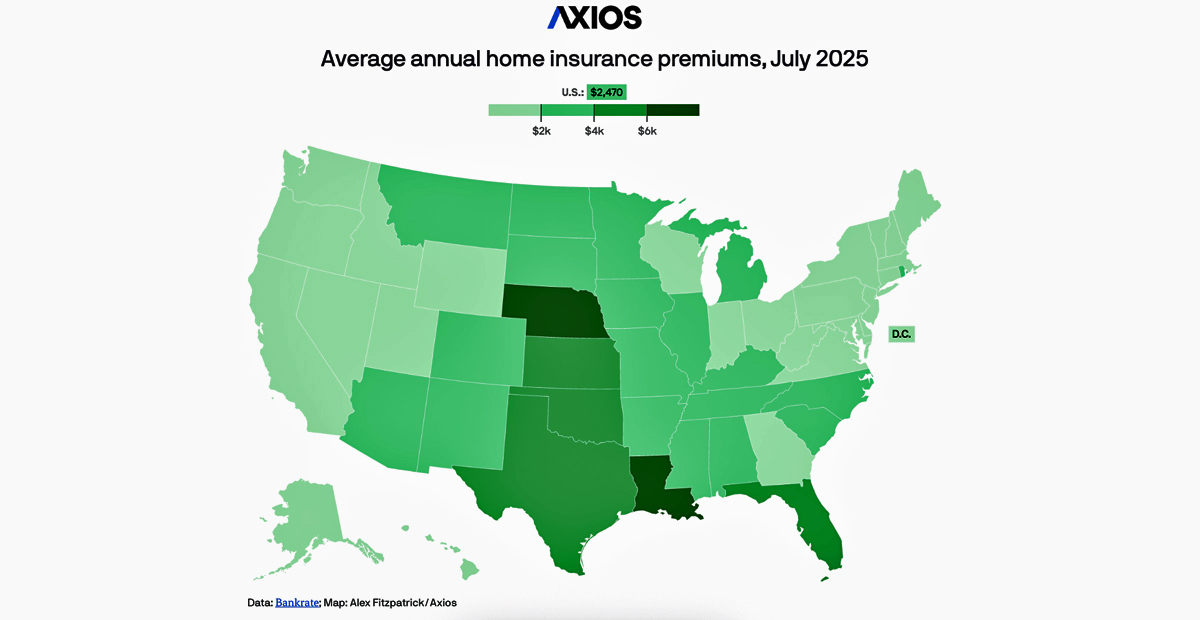
As climate change supercharges our weather, our risk of loss increases – and that is making insurance premiums much more expensive. The national average for home insurance is up 9% since 2023 and, as this graphic shows, it’s particularly high across the Midwest and South.

Notable Quiz

This month, instead of watching a video, we hope you’ll take this interactive, eye-opening New York Times quiz. You’ll learn a lot about what you need to do to keep yourself and your loved ones safe if you’re faced with a climate disaster.

Read More
Sign Up for News!