
Category: Athens





Athens Newsletter – August 2025
Dear Friends,
Since we began compiling this digest of local and statewide climate news in Georgia, we’ve both weathered storms and basked in the glow of progress. Cleantech has given us high hopes through high-paying jobs and economic growth across our state. At the same time, we’ve been deeply concerned about how climate change is affecting our ability to stay safe and thrive.
We all agree that we need reliable, affordable energy, but our economic future also depends on a stable climate. We need to be clear-eyed about the risks if we want our wonderful Peach State to thrive. As a group of citizens concerned about the economic, health, and national security impacts of climate change, we hope to build consensus across the political spectrum about the urgent need to address it. We welcome your support and ideas. Please reach out to us!
Sincerely,
The C-Change Conversations Athens Team
Georgia News of Hope
Americus, GA, is attracting economic development by embracing clean energy projects. Three solar companies have collectively invested $736 million in the region and will create more than 2,000 jobs in what could become the largest solar array east of the Mississippi.
Electric vehicle company Rivian will establish an East Coast headquarters in Atlanta. The company plans to hire 500 employees for this location by late 2026. This move supports its upcoming $5 billion Georgia factory and marks one of Atlanta’s largest office investments this year.
Kia Georgia is installing a 3.2-million-square-foot solar panel canopy at its West Point plant to generate clean energy and protect thousands of vehicles from hail damage. The project is expected to produce enough electricity to cover 20 to 30% of the factory’s needs.
An Augusta-based golf cart manufacturer sent two electric vehicles to Pope Leo XIV to use during international visits. The new pope has spoken out about the urgent need for climate action.
An Emory University nursing professor has helped develop a sensor patch to protect farm workers from the dangerous effects of extreme heat. The patch connects to a smartphone and monitors vital signs like heart rate, skin temperature, and hydration to provide real-time alerts to prevent kidney damage and heatstroke. Farm workers are 35 times more likely than others to die from heat-related causes.
The Firefly Trail secured a second major grant of $2.9 million to finance the construction of a 4.5-mile paved section from Maxeys to the Greene County line. This grant advances a plan to create a 39-mile recreational trail from Athens to Union Point along a former railroad corridor that will allow people to explore surrounding rural areas by bike or on foot.
Georgia News of Concern
Many Georgians were shocked by their power bills this summer. Recent rate hikes combined with higher summertime usage pushed the average household Georgia Power bill to $266 in July. Athenians spend a higher percentage of their income on energy than the state average – and more than double what the average American pays. In some of the lowest-income neighborhoods in Athens, residents are spending nearly 30% of their income on energy bills. And a program that would have provided free rooftop solar leases to hundreds of low-income homeowners lost its funding just one day after its launch in August when the Trump administration canceled the “Solar for All” grant.
As energy demand continues to increase, Georgia Power proposed a historic 10,000-megawatt expansion of the utility’s power generating capacity. The bad news is that the plan relies heavily on building and purchasing new gas-fired power plants, locking customers into decades of gas dependency that exposes them to volatile fuel prices and contradicts climate goals. The Georgia Public Service Commission will hold public hearings in October and December before voting to approve this expansion.
Sweltering summer heat in Savannah forced its city council to set a temperature limit for operating horse-drawn carriages that carry tourists through historic downtown. Before the August vote, carriage horses had been working in temperatures up to 95°F or a heat index of up to 110°F. That threshold will drop to 85° or a heat index of 91° next summer.
A new study revealed that 72% of Georgia’s coastal marshes have experienced belowground biomass loss since 2014, a critical indicator of marsh failure caused by increased flooding pressure from sea-level rise. Marshes defend against coastal flooding, filter water, and store carbon.
Ways to Act
Athens is one of the few cities where the U.S. Postal Service has deployed its electric mail trucks. The next-generation vehicles stay quiet and cool, and drivers rave about them. Despite local and national excitement about its plan to create a mostly electric fleet, the Postal Service is facing congressional efforts to strip its $3 billion in federal EV funding. Canceling the program would waste millions already spent and squander a critical opportunity to reduce air pollution from the government’s largest fleet, especially since the mail trucks’ short, stop-and-start routes are considered an ideal application for EV technology.
An $80 million federal grant to Blue Bird Corporation’s bus manufacturing facility in Fort Valley, GA, is also threatened. Approved in 2023, the funding is crucial for expanding the plant and increasing the manpower needed to meet the growing demand for electric school buses. Please reach out to your senators and representatives to express your opposition to efforts that would strip funding for electric postal trucks and buses.
Third Act Georgia will present Sun Day Sunday on Sept. 21 in Winterville’s Marigold Auditorium. The free events will feature the Sun Day Choir, local sustainability experts, demonstrations of solar products, tables with information on renewable energy, free children’s books, and free sundaes.
TheBig Picture: U.S. and Global Climate News
When is winning really losing? It’s when the results of victory cause the opposite impacts than desired, harm supporters more than opponents, and boost your biggest competitor.
The Trump administration’s stance on energy is indeed a losing proposition. It purports to provide cheaper and more secure energy, but in fact drives up costs and limits supply at the exact time that our demand and electricity prices are soaring.
Producing new electricity from utility solar in America today costs as little as $38 a megawatt hour: the most efficient natural gas plant provides the same amount of energy for $107. Solar and battery projects can come online in two years; natural gas plants typically need a five-year runway, in large part due to a shortage of turbines. In short, thwarting new clean energy is making us less energy secure. Consumers will pay for it – experts predict policy changes will make electricity prices rise up to 18% over the next decade, or $192 per average household on an annual basis, and increase the risks of blackouts.
In the big picture, who is being harmed the most? Rural and “Red” America. About 80% of the job and economic growth from clean-energy investment was planned in Republican-leaning districts. That investment has already dropped by a third over the first half of this year versus a year ago. And while anti-wind action has harmed offshore projects, it has impacted the country’s “windbelt” the most – the highest losses are in Texas, with Idaho, Iowa, and Nebraska not far behind.
On the international front, the United States’ reversal is allowing China to extend its lead in this lucrative sector, which provided 10% of China’s GDP growth last year. China is becoming the “one-stop shop” for clean energy. And increasingly, its clean-energy products are superior to fossil fuel versions. For example, China produces EVs that can charge in five minutes, run for 600 miles, and cost significantly less than combustion engine cars. China is also exporting solar and wind technology around the world, enabling developing countries to manufacture “homegrown” electricity that is more secure and less expensive than fossil fuel imports.
And in a stunning role reversal, CO2 emissions in the U.S. rose 4.2% in the first half of 2025, while China’s fell 2.7%. As the U.S. leaves the Paris Agreement and disparages climate action, China is positioning itself as a climate leader, announcing a partnership with the EU to lower climate heating and calling the Paris Agreement the “cornerstone of international climate cooperation.”
It doesn’t feel good to be a loser – to pay more for less. We want our country to be the winner, to build the energy systems of the future, to save money, and to provide a healthier, more economically secure world for our kids and grandkids.
Don’t you?
News of Concern
The administration is working hard to create cover for its unraveling of climate science and action, including a recent DOE report that scientists say is filled with “error, bias, and distortions.” In one glaring mistake, the report states that Arctic melting is minimal, shrinking 5% since 1980. The actual number is 40%. The AP and other news outlets have debunked much of the report’s information, but the administration’s misinformation campaign is incredibly effective, and dangerous, because many people believe that narrative – and that belief precludes them from taking action to stay safer.
And we all need to get ready for climate change, as was so clearly evidenced by the tragic flooding in Texas in July. The flooding was made worse because of two climate impacts. First, warmer ocean waters and a warmer atmosphere enable more water vapor to be held in the atmosphere – for every degree Celsius increase, the atmosphere holds 7% more vapor, and that means floods will continue to get more dangerous. Second, the ground was parched from a drought exacerbated by higher temperatures, and the soil could not absorb enough of the flooding to slow it down. These one-two punches are becoming more frequent in our country and all around the world.
We’re also seeing a one-two punch when it comes to protecting ourselves from supercharged weather events. Hail, for example, is getting larger as the climate warms up, causing $20-$35 billion in losses annually, according to insurance experts. But impacts fueled by climate change are making it increasingly difficult to get affordable insurance, especially in the Midwest, where premiums are skyrocketing. As noted above, our electricity rates nationwide are also soaring – in large part due to the cost of making our grids more resilient to wildfires, storms, and heat waves. Almost 40% of recent cost increases are from upgrading and hardening our grid – and making repairs after extreme weather events is driving up costs as well. This affordability challenge will only get worse as energy-hungry AI centers come online – a single center can require as much electricity as an entire mid-sized city.
Costs are also being driven up by the administration’s action to keep inefficient coal plants online. Coal only provides 15% of our electricity, but it is the most expensive fossil fuel. Keeping these plants running instead of replacing them with cheaper (and cleaner!) fuel sources will cost utility customers billions of dollars.
But there are things happening that are perhaps even more concerning than these direct hits on clean technology. The administration is dismantling much of our scientific expertise, limiting our ability to measure climate change impacts to help farmers, businesses, communities, and families prepare for climate changes. And in a move that would handicap future administrations’ ability to regulate greenhouse gases, the EPA wants to rescind a landmark finding that declared CO2 and other emissions are a danger to our health and welfare.
We know climate change affects our health, but we don’t yet know how to put a cost on how it impacts our happiness and mental health. For many of us, summer has always been an idyllic state of mind as much as a season of outdoor pleasures. But in many places it has become so much more hot and sticky – so much so, scientists have created a new metric to measure “stickiness.” Even the Steve Miller Band, musical mainstays of the summer stage, canceled its 2025 tour because of the risk of extreme weather.
It’s giving us the summertime blues, literally and figuratively. And we have to wonder, what we’re gonna do…
News of Hope
However, at the same time that the U.S. government is trying to minimize action on climate change, the highest court in the world just elevated the issue in a powerful way heard around the world. By recognizing that a healthy climate is a human right, and claiming that countries have a legal obligation to protect the environment from greenhouse gases, the International Court of Justice is holding countries accountable to action – a much-needed bolstering in the drive to lower emissions.
It’s a global issue that needs global action, and a recent move by the European Central Bank could have far-reaching impacts. By integrating a “climate factor” into its financing operations, the bank is doubling down on holding companies accountable for their carbon footprints and upping the motivation for creating cleaner products and processes.
More good news – about 90% of the world’s new renewable energy is now cheaper than power from fossil fuel generation. The world saved almost $500B in energy costs in 2024 using renewables versus fossil fuels. And momentum is growing, with the EU spending 63% more on renewables in the first half of 2025 than a year ago, even as the U.S. investment declined.
And climate action is moving forward, even if it’s in a whisper instead of a roar. Banks are quietly pulling funding from fossil fuels lending and investors are piling into renewable energy, even though they are doing it quietly and withdrawing from associations that could spark the administration’s ire.
We also saw great hope in a recent test of a critical concept in California. The state successfully tried out a two-way grid in July, drawing power from more than 100,000 residential batteries to provide electricity. This model holds great promise, especially as the demand surge from AI and electrification is challenging our existing system. If end users can store and sell energy back to the grid during peak usage periods, it changes the equation dramatically – we’d no longer need to build the same quantities of new power generation facilities.
Adaptation is key to protecting ourselves, our loved ones, and our communities. Two cool new gadgets really got us excited. They’re both sensors designed to keep us safe – a pinecone-sized device could give people a leg up on staying safe from wildfires and a patch that farm workers would wear to monitor vital signs while working outdoors in extreme heat. Ideas like this can change our world one person at a time, making it possible for us to have a healthier future – imagine that.
Notable Graphic
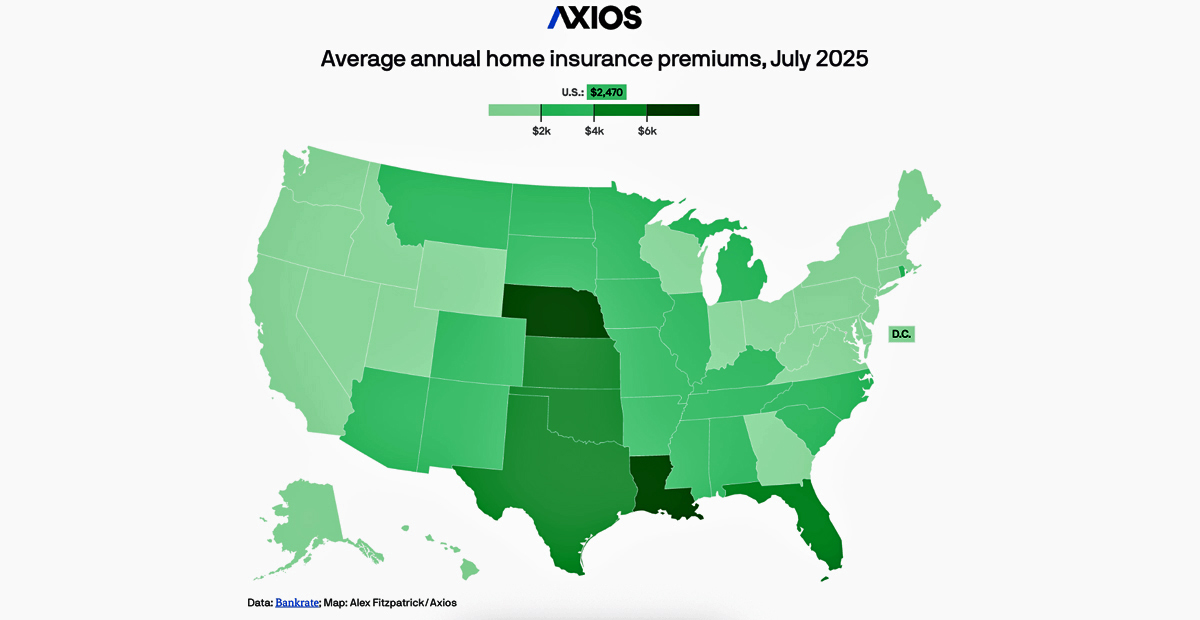
As climate change supercharges our weather, our risk of loss increases – and that is making insurance premiums much more expensive. The national average for home insurance is up 9% since 2023 and, as this graphic shows, it’s particularly high across the Midwest and South.
Notable Quiz
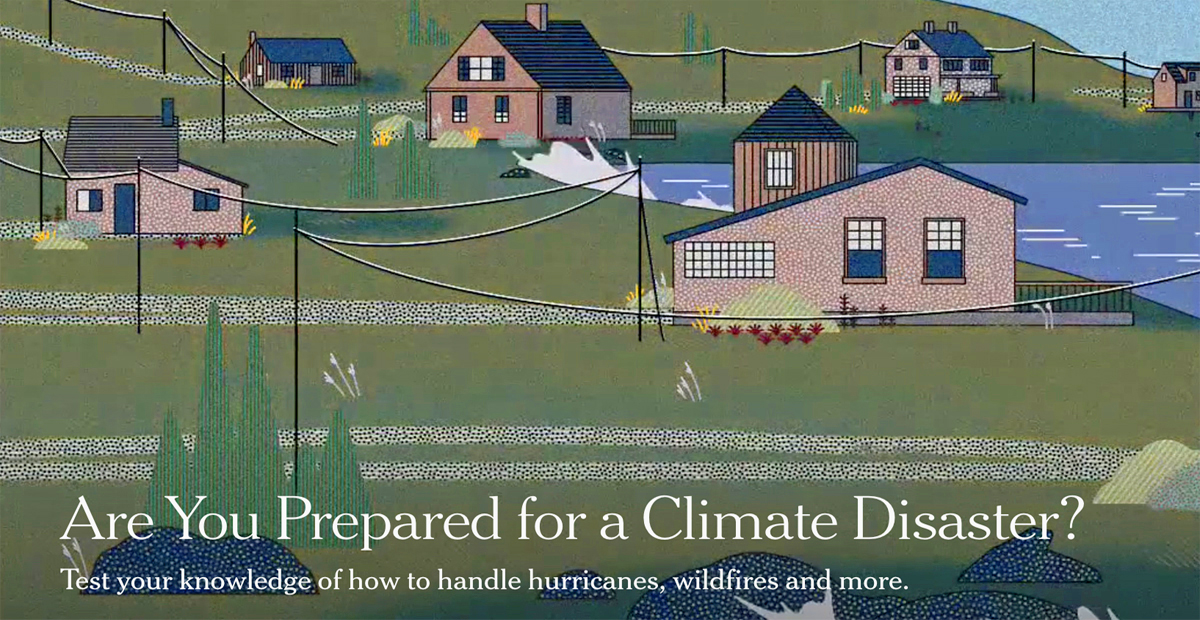
This month, instead of watching a video, we hope you’ll take this interactive, eye-opening New York Times quiz. You’ll learn a lot about what you need to do to keep yourself and your loved ones safe if you’re faced with a climate disaster.

B-Change Blog: Reducing Food Waste Helps the Climate

B-Change Blog: Helping Solve Climate Change by How We Shop

by Karen Dougherty
Here’s a fact that may surprise you: the global fashion industry is a leading contributor to climate change. And because people don’t often make the connection between their shopping habits and rising temperatures, it’s a sneaky culprit.
Our point isn’t to make you feel guilty about shopping – but the more we know about the causes of climate change, the easier it is for us to make behavioral choices. Every single item we buy has to be produced, packaged, and shipped, either to us as individual consumers or to a store. Each step along the way uses energy and resources, emits heat-trapping gas, and creates waste. Just like with every industry, some companies are more responsible than others. The worst offenders are those making high volumes of cheap clothing in the trends of the moment, a.k.a. “fast fashion.” Mass-produced clothing is often made overseas, in locations where exploitation of workers and environmental pollution can make a bad situation worse.
The textiles themselves are also problematic. Natural fibers like cotton require a shocking amount of energy and other resources to produce, but synthetic fabrics have their own set of drawbacks. Even high-quality brands use polyester and nylon, which are made from oil and contain plastic. Synthetic fabrics shed microplastics during manufacturing and throughout the rest of their lifecycle.
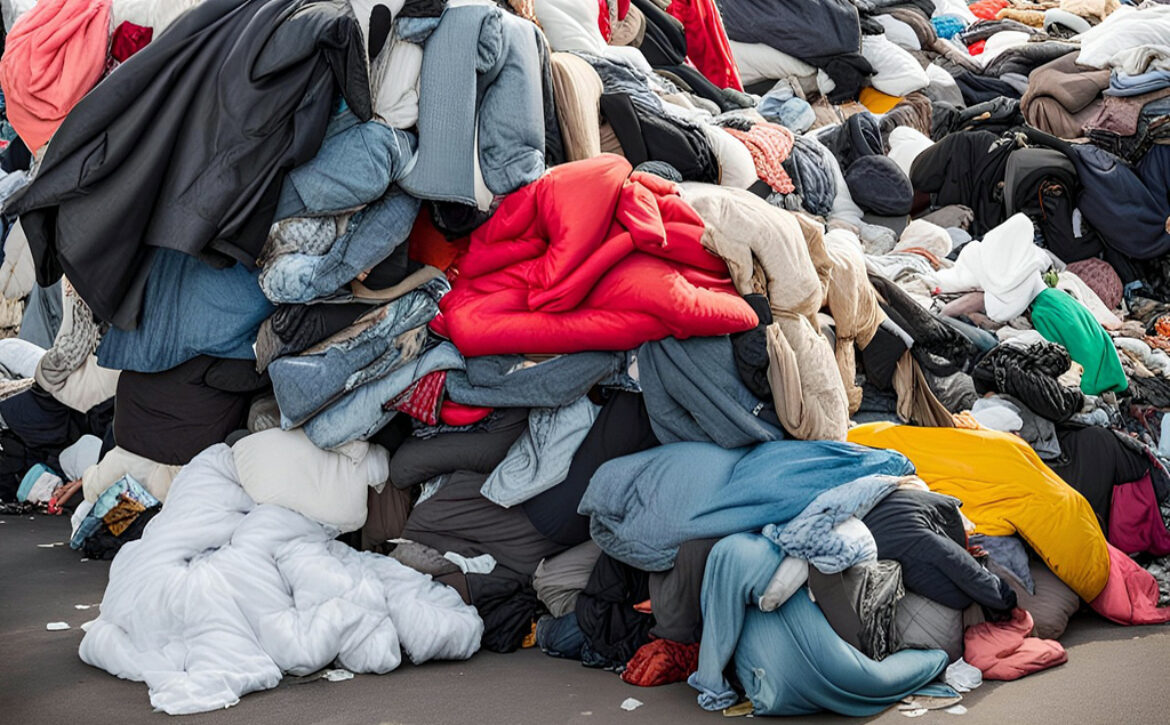
The problem continues even after we are finished wearing a piece of clothing. Sadly, donating isn’t as helpful as we think – an estimated 85% of used clothing ends up in landfills, where it releases methane, a potent heat-trapping gas. Further, because of the plastic content, it may live there forever.
Eye-popping facts about the fashion industry:
- The global fashion industry is responsible for roughly 10% of carbon emissions.
- The industry emits more heat-trapping gas than all international shipping and flights combined.
- It takes around 1,000 gallons of freshwater to make one pair of jeans!
- Every second of every day, a garbage-truck-sized load of clothing is dumped in landfills.
- The average American tosses 70 pounds of clothing each year.
- Over 100 billion items of clothing were made in 2020, double the number in 2000.
Industry-wide change is needed
In order to solve our climate problem, the industry needs to adopt system-wide change. Many companies are responding by reducing their emissions, and are using more sustainable fabrics and manufacturing processes. Some are certified as B Corps, meaning they meet a set of environmental and social governance standards. Consumer demand for these options will help force change.
An inadvertent upside of tariffs
There are new economic factors at play that may have the inadvertent effect of slowing fast fashion and overconsumption, which would ultimately reduce industry emissions. Clothing made inexpensively overseas and imported into the United States is facing new tariffs, including the closing of a key loophole that is expected to lead to higher prices and slower shipping times. This may make the trend of over-buying less appealing.
What can we do?
When it comes to clothing – or any consumer product – the formula is fairly simple: buy less, choose sustainable options, use longer, and recycle more.
Here are some clothing-specific ideas:
- Resist fast fashion and choose quality over quantity
- Patronize sustainable companies, including B Corps
- Shop vintage, either through a local consignment shop or an online site
- Consider a clothing rental company if you plan to only wear an item a few times
- When it’s time to let go, give some thought about how and where to donate, recycle, or sell
Consumer demand can help motivate companies to change how they operate. We can be a part of the solution by investing in fewer, more sustainably-made pieces of higher quality. It may feel like a small change, but it can really make a meaningful impact.
In addition to volunteering for C-Change, Karen blogs about climate change at unheating.com.

B-Change Blog: Eat Less Beef
B-Change Blog: Eat Less Beef
By Karen Dougherty
How many times a week do you typically eat beef? Did you know that dropping that number, even by one, would help solve climate change? It’s true. There is a strong relationship between meat consumption and our rising temperatures. Choosing a meatless meal is great, but even replacing steak with chicken, or ground beef with ground turkey, makes a whopping difference.
Why is there so much focus on beef? The main reasons are: methane, land, and resources. Add these together and the impact of beef consumption on heat-trapping emissions is staggering.

Source: Our World in Data
Methane
When we think of heat-trapping gas, carbon dioxide comes to mind first. Rightfully so – it is the biggest offender, and it lingers in the atmosphere for a very long time. But another major culprit is methane. Methane is especially problematic because, although it dissipates from the atmosphere faster than CO2, it has at least 25 times the heat-trapping potency. Methane is responsible for 20-30% of the temperature increases due to climate change, so decreasing its levels is one of the quickest and easiest ways to slow down warming.
Cows are a major source of methane. The unique digestive system of ruminant animals like cows, sheep, and goats is to blame. Methane is a by-product of their digestion, released into the air through their gas. With over 1.5 billion cows on the planet, the problem is immense.
There are some cool solutions being studied to reduce the amount of methane coming from cows. One fascinating example is adding seaweed to their diets. It significantly reduces methane emissions. Solutions like these are coming, but aren’t quite ready for widespread adoption.
Land
Raising animals for food requires a lot of land, and larger animals take up more space. Although it doesn’t seem like it when you fly across the Midwest, farmland is a limited resource. The more land we use for cattle, the less we have for growing crops. Massive amounts of land are also needed just to grow enough food to keep cattle fed.
Did you realize one driver of deforestation in the Amazon is to clear land for cattle? Americans have such an appetite for red meat we can’t fulfill our needs domestically, so we import from other countries, including Brazil.
Resources
In addition to needing more space, bigger animals use more resources. They eat more, drink more water, and require more energy to raise and process – and to be transported around the country or the world. Slowing our intake of beef would reduce emissions from all these sources.
Other benefits
I’m a big fan of climate solutions with multiple benefits. If we cut back on red meat consumption, there are other wins for us, namely saving money and improving our health. Beef is generally more expensive than other animal proteins, and a diet high in red meat is linked to increased rates of certain cancers, type 2 diabetes, and heart disease.
Nobody is going to force us to stop eating beef, but if we choose to make even small changes to our consumption, it could be a win-win for our health, our budgets, and our climate.
In addition to volunteering for C-Change, Karen blogs about climate change at unheating.com.


Athens Newsletter April 2025
|
|

|
|
|
|
|
|

|
|

|
|

|
|

- 1
- 2