APRIL 2026
Dear Friends
Since we began compiling this digest of local and statewide climate news in Georgia, we’ve both weathered storms and basked in the glow of progress. Cleantech has given us high hopes through high-paying jobs and economic growth across our state. At the same time, we’ve been deeply concerned about how climate change is affecting our ability to stay safe and thrive.
We all agree that we need reliable, affordable energy, but our economic future also depends on a stable climate. We need to be clear-eyed about the risks if we want our wonderful Peach State to thrive. As a group of citizens concerned about the economic, health, and national security impacts of climate change, we hope to build consensus across the political spectrum about the urgent need to address it. We welcome your support and ideas. Please reach out to us!
Sincerely,
The C-Change Conversations Athens Team
Georgia News of Hope
Georgia Power will soon allow companies to propose and fund their own clean-energy projects connected to the utility’s grid. Previously, large corporate customers like Meta and Hyundai had no mechanism to bring such projects directly to Georgia Power, forcing them to rely on renewable energy credits. Now businesses can support the grid by building in-state solar or other renewable projects. The program could serve as a national model, as it could help meet rising energy demand from data centers and reduce the need for new natural gas generation.
New Bethel AME Church in Lithonia has become the first commercial pilot participant in the Georgia BRIGHT and Capital Good Fund program to install both solar panels and battery storage. This initiative aims to turn congregations into resilience hubs that can provide emergency power, shelter, and support during climate disasters. The solar system at New Bethel is expected to meet 80% of the church’s energy needs and save more than $15,000 per year.
Decatur is launching a curbside residential composting program. After determining that a city-run program was infeasible, the city commission approved a contract with CompostNow, an organization that will handle logistics and return finished compost to local farms and community gardens. The program aims to reduce food waste, a major contributor to landfill volume and methane emissions, while producing nutrient-rich soil for regional agriculture.
The University of Georgia is tackling food waste through a combination of AI technology, composting, and food donation. A new program called Raccoon Eyes uses AI to analyze photos of plates returned on dining hall dish conveyors to help UGA improve future menus. Since its launch in fall 2024, the dining halls have seen a 21% reduction in food waste. Leftover food is composted and sold to local farmers, and unserved prepared meals are donated to Full Plate, a program serving people experiencing poverty or homelessness.
Georgia News of Concern
More than 120 homes were destroyed last month by climate-fueled wildfires in south Georgia. Read on for a broader exploration of why wildfires are becoming a bigger risk.
Extreme drought and warming temperatures are intensifying mosquito-related risks. While swamps and rivers dry up during prolonged droughts, stagnant water remains in underground storm drain systems, creating ideal breeding grounds for mosquito larvae. Meanwhile, rising temperatures are driving mosquito species typically found south of the equator northward into Georgia.
Climate change is disrupting golf by posing health risks to players and altering course conditions, according to the International Golf Federation. This is bad news for Georgia, where the golf industry generates $5.3 billion a year.
Ways to Act
Consider the climate when you vote! Athens mayoral candidates recently addressed climate resilience, ACC’s Clean and Renewable Energy Plan, and data center regulation during a forum on energy and the environment. You can read about it or watch the forum to learn more about where the candidates stand.
Drawdown Georgia has published Georgia-specific climate projections for heat and rainfall trends through 2050 that explore how different decisions we make today will affect our future climate. To better understand these climate projections, watch this interview with Marshall Shepherd, an internationally recognized climate scientist at the University of Georgia. Share these projections with friends and family to start a conversation about mitigation and resiliency.
The Big Picture: U.S and Global Climate News
Here come the wildfires. They are popping up in all sorts of unusual places and spreading toxic smoke for hundreds, if not thousands, of miles. And if they feel like they are “bigger and badder” than in the past, they are: NASA confirms that our fires are burning larger, hotter, and longer than in past decades.
The fires in Georgia and Florida in April were a special delivery from our overheated climate. Hot, windy days, drought conditions, and an excess of dry, fallen trees from recent hurricanes created the perfect fire conditions. And while we don’t hear about them as much, the wildland fires in the Arctic are even more concerning. They are very big – much larger than the state of California – and are burning down top layers of permafrost and exposing methane-rich lower layers to the atmosphere, locking in more climate change.
Wildfires are a tough challenge. Forest management and prescribed burns can help lower their intensity, but the scale of the problem is overwhelming as “fire conditions” become more common across the country. The amount of smoke we are exposed to is increasing – research shows Americans are breathing in four times more smoke since 2020 than a decade ago. That smoke is extremely toxic: it contains small particulate matter that can pass through our lungs into our bloodstreams, causing inflammation, heart attacks, strokes, lung disease, and even cancer.
The frustrating part? We have the tools in hand to stem the damage to our climate and save more of the world for future generations.
Many Americans understand climate change is happening, but too few believe it will impact them personally. Maybe as climate impacts grow and our insurance rates soar, our food becomes more expensive, and our home values teeter, we will begin to care more. Maybe it will take a wall of flame or a blanket of choking smoke for some to truly understand that the threat is real, and it’s coming. But I sure hope not. The sooner we act, the safer we will be.
Notable Quote
“You actually cannot stop a lot of these really large intense wildfires. They’re simply too big.” — Liz Henderson of Swiss Re, the world’s largest reinsurance company
News of Concern
At the same time that our land is heating up, climbing global temperatures are wreaking havoc in our oceans. Right now, the Pacific is experiencing an intense heat wave that has implications not just for marine life, but life on land as well. Warmer oceans contribute to hotter, longer heat waves (like we experienced in March) and supercharged rainfall. Pair this with the strong El Niño that is predicted for this summer, and we could be in store for some dangerous weather ahead.
As we worry about coming weather woes, we were also concerned by many headlines this month:
- After an extremely dry and hot winter across the U.S., a wide range of crops and cattle are in a precarious state – and it’s likely to hit both our farmers and our grocery budgets hard. Beef prices are already 14% higher than winter a year ago, and are projected to go up another 10% by year’s end.
- Climate change is making our lives less affordable, from health costs to home-related costs, a new study shows. The big picture? It’s cheaper to pay for climate action than to pay for climate damages.
- Support for developing fossil fuels over renewables has doubled among Republicans over the last six years, reaching 71% and widening the partisan spread.
- Senate Republicans introduced a bill to provide immunity to fossil fuel companies from laws or lawsuits that hold them accountable for climate damages. This push comes as major fuel companies face a growing wave of lawsuits from cities, states, and individuals.
- After courts ruled past actions to curtail renewable growth were illegal, the administration expanded a new strategy: paying companies (using taxpayer dollars) to halt offshore wind projects and invest in fossil fuels instead.
- The Atlantic Meridional Overturning Circulation (AMOC), an ocean current that is a critical part of our global weather systems, is weakening faster than predicted. It could collapse within 150 years, bringing significantly harsher winters to Europe (think -4°F in London) and dramatically increasing sea level rise along the Northeast coast of the United States. This is an excellent explanation of how AMOC works, why it’s changing, and what the impacts will be.
News of Hope
We achieved a major milestone in the energy transition: the world produced more electricity from renewables than from coal last year. Coal, the dirtiest fossil fuel, had been the primary fuel for global electricity since the Industrial Revolution. Another milestone? Wind and solar grew so much, they began to displace fossil fuels within the electricity sector for the first time. Even in China and India, two of the world’s top emitters, coal use dropped and solar soared last year. In contrast, U.S. coal use increased 13%.
And while the war in Iran has plunged the world into an oil crisis, there’s a silver lining – globally, rising gas prices are prompting increased consumer interest in electric vehicles. Last year, EVs around the world displaced 1.8 million barrels of oil demand a day (equal to 13% of all U.S. oil output) and the IEA predicts these vehicles will displace more than 5 million barrels of oil a day by 2030.
In other optimistic news about EVs this month:
- Used EV sales just jumped 12% versus a year ago as Americans responded to war-fueled gas prices. And while our charging network still isn’t fully up to speed, experts expect infrastructure to expand this year.
- Coming soon: EVs that can go nearly 1,000 miles on a charge! As battery technology improves by leaps and bounds, these cars are becoming superior to gas guzzlers in every way.
- Rivian is thinking outside the box for its EV production facilities. The company is using its own old vehicle batteries to power its Illinois factory – now that’s reduce, reuse, recycle!
Representatives from nearly 60 nations met in April for the world’s first global conference on transitioning away from fossil fuels. (The U.S., China, and India were not invited.) This conference was in direct response to oil-, gas-, and coal-producing countries, which have continued to block agreements on fossil fuels at the annual United Nations climate talks, known as COP. While no enforceable outcomes were adopted this year, organizers hope this will set the tone for COP 2026 and add momentum to global decarbonization.
To end on a feel-good note: reforestation and rewilding in tropical land seems able to occur much faster than scientists once believed – in a matter of decades rather than centuries. Healthy forests are so important to moderating our climate and sequestering carbon, so this news indeed brings us much hope.
Notable Graph
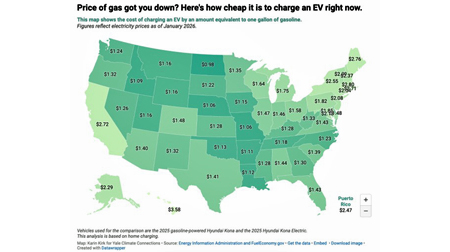
As U.S. average gas prices hit an all-time high as we wrote this newsletter, these EV charging prices are looking pretty good. As we said above, the fast pace at which EVs are becoming cheaper and more reliable means it’s only a matter of time until many more of us are able to benefit from being part of this growing fleet.
Notable Video
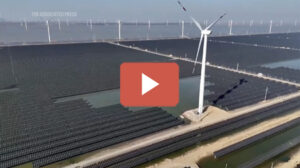
Solar is the fastest-growing electricity source in history – and global solar power generation grew by a whopping 30% in 2025. China remains the driving force behind this surge, with India quickly picking up the pace. These two nations – fossil fuel heavyweights – are leading our transition.