nov-2020

November 2020 Climate Change News

Hands down, the most prominent news in the month of November was the presidential election and its long tail. Poll watchers have been debating the role that global warming played in the vote. Many see climate as key to victory, while other analysts aren’t so sure, pointing to mixed messages from the electorate. Whatever the poll parsing ultimately concludes, this was certainly the first presidential election in which climate played such a prominent role. Furthermore, November was a month when even more large American institutions – including conservative institutions with a history of denial – saw the climate handwriting on the wall … and united around its mandate. 

We hope you enjoy this month’s roundup of climate news and welcome your feedback and questions.

Warmly,
The C-Change Conversations Team

Notable Video
Let’s start with a win-win. Take a look at this “new” food that will please our palate while helping save the planet. 

News of Hope
It is extremely promising to anticipate a U.S. administration mobilizing to battle climate change from every cabinet department simultaneously.

It’s equally promising to see groups that have previously denied anthropogenic global warming (or that have resisted efforts to address it) now suiting up for action. The American Farm Bureau Federation is the latest big organization to agree that the impacts are just too profound to ignore. And this month the Federal Reserve for the first time identified global warming as a risk to financial stability. (Readers might remember that the U.S. Chamber of Commerce did an about-face on climate last year and President Trump’s Commodity Futures Trading Commission released a report with warnings of grave financial consequences last month.)

As these institutions turn their attention to climate, renewable energy sources look increasingly robust as economic pillars. The International Energy Agency (IEA) has upped its growth projections for the renewables sector and now sees wind and solar installations setting records. The IEA also issued a detailed report with a clear bottom line: sector growth is outpacing expectations even through the COVID downturn.

And in one of those wonky details that may be critically important, a new look at the efficiency of burning fossil fuels suggests that transitioning to renewables may not be as big a reach as previously thought. That’s because only about 1/3 of the energy stored in coal is converted to power on average and only about 1/5 of the energy stored in gasoline is converted to auto propulsion. The rest ends up as waste heat. Renewables pack a much better punch. So that means we will need less “new” energy to replace the work of the “old” energy – though it’s still a daunting task.

News of Concern
The hard work of transitioning, of course, is still ahead – and the harsh impacts of global warming aren’t slowing down. New research shows the inland damage of hurricanes is greater than before because tropical storms no longer lose as much force when they hit the shore. And homeowners in the paths of climate disasters are having more trouble getting insurance, threatening local communities with economic disaster. The choice ahead could be painful, allowing climate-endangered communities to decline as insurance costs get out of reach or asking the rest of the country to foot the escalating bill.

Meanwhile, on the health front, a new study predicts that a warmer climate will dramatically increase the spread of diseases among wildlife over the next five decades. This is also bad news for humans because 75% of our new diseases start in the wild. COVID-19 is an example of how deadly these diseases can be. The International Red Cross, while on the front lines of the disease spread, this month declared climate change a greater danger than the pandemic and demanded a similar urgency from world leaders to coordinate a response. 

And speaking of animals, National Geographic reports that methane flares in America’s 2,627 landfills are causing widespread destruction to bird populations around the country. Methane is a potent greenhouse gas released by decomposing landfill waste (and by other natural and human processes including leakage from oil and gas production facilities).

Notable Quote
“There are three categories of truth: personal truth, political truth and objective truth that shape our understanding of the universe. The interesting thing about objective truth is that it is true no matter what.”

Science communicator and astrophysicist Neil deGrasse Tyson

Read More
washington-post-logo

To Get Action on Climate Change, the People Must Demand It

Catherine Rampell missed a key point in her Oct. 27 Tuesday Opinion column, “Biden’s energy ‘gaffe’ is the truth: Oil is history.” Though it is true that “politicians can make a difference” and “accelerate the pace of change,” the reason lawmakers haven’t, of course, is that they aren’t hearing from enough constituents that addressing the threat of climate change is a priority.

Read More
october-2020-thumbnail

October 2020 Climate Change News

Welcome back to our monthly roundup of climate news … both encouraging and, well, not-so-much. Just days before the presidential election, though, it’s striking to note more optimistic signs than expected. And we’re not alone. Some are describing a ‘sea change’ in the way the American electorate, politicians, and business people are now talking and acting on the issue of global warming. We concur. To set the tone, watch this new video about the biggest, baddest vehicle of the automotive world — which is now electric! The closing lines say it all.
 
Warmly,
The C-Change Conversations Team

Notable Quote
“Introducing the world’s first all-electric supertruck, the revolutionary GMC Hummer EV, with no limits, no emissions and no equals. It will leave everything you thought possible in a cloud of dust.”

– General Motors marketing video for the new electric Hummer
 

News of Hope
Let’s turn to the presidential debates. In a sign of a sea change, the final debate between President Trump and former Vice President Biden was the first in 20 years to feature a substantive discussion about climate change. Even more important: the issue was treated as fact by both candidates who then sparred over policies.

While Biden made news by calling for a speedy transition away from fossil fuels, the world’s oil companies largely shrugged at the proposition, which many have already incorporated into their business plans. And coal? After years of retraction, the coal companies clearly see the handwriting on the wall and are divesting from coal themselves.

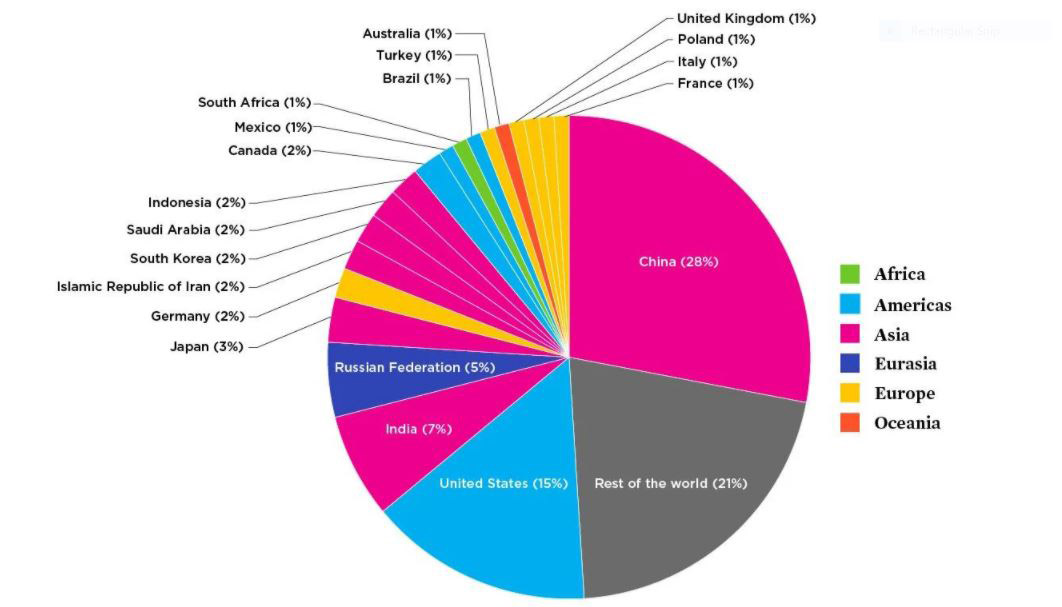
Meanwhile at the United Nations, the leader of the world’s biggest greenhouse gas emitter pledged to achieve carbon neutrality in its economy by 2060. Yes, China— the country currently burning half the world’s coal supplies (see the pie chart, below). China has expressed good intentions before but this commitment from its top politician has been followed up by a concrete plan charting a viable path to get there.

While many researchers in the U.S. are developing similar plans to transition the U.S. economy, it’s encouraging to see evidence that American workers are beginning to recognize that job growth in clean energy is outstripping job losses in fossil fuels. A sea change, indeed.
 
News of Concern
Of course, a sea change doesn’t mean smooth sailing. The annual report of the world’s most authoritative body of energy analysts, the International Energy Agency, concluded this month that the globe is headed toward more warming than the top manageable limit set by the Paris Agreement.
 
Meanwhile, another international body — the G20 (the premier forum for the world’s largest economies) — backtracked on previous commitments to end oil subsidies. The rationale cited was the disruption to oil markets caused by the coronavirus pandemic.
 
On the theme of backward movement, Bloomberg News divulged leaked documents from Exxon Mobil showing plans to increase the company’s annual CO₂ emissions by 17 percent by 2025. This trajectory clashes with plans by Exxon’s main industry rivals to reduce emissions and cut fossil fuel production.
 
Exxon’s short-sightedness may be part of another sea change we’ve witnessed this month: the Dow dropped Exxon Mobil from its index in favor of a software stock. XOM had been part of the Dow Jones Industrial average since 1928 and was its longest-serving component.
 
And lest we forget the climate-linked fires still burning in the West, consider this: a growing body of research shows significant and enduring health risks from wildfire smoke. That’s an extra layer of pain on top of the coronavirus pandemic and the arrival of flu season.
 
Notable Graph
When taking second place is not to be congratulated. How countries compare in CO₂ emissions(Source: Union of Concerned Scientists)

Read More
oct-newsletter

October 2020 Newsletter

Welcome to the fall edition of our quarterly newsletter. As you will see below, we are committed to reaching new audiences – even during the pandemic – and extending our impact far and wide.
 
In the Northeast, the leaves are beginning to turn, splashes of vibrant colors erupt across the tree-scape, and we are reminded of the ever-constant flow of seasons, the consistent and comforting rhythms of nature. Yet, at the same time, we are experiencing nature in ways that are no longer consistent or comforting – whether it’s the hottest temperature ever recorded earlier this year, running out of traditional names for tropical storms because we’ve had so many, or the behemoth “gigafire” (an unprecedented 4 million acres) burning in California. These events underscore that our world is evolving, made more dangerous by climate change.
 
There is just so much vying for our attention – the pandemic, the election, racial injustice, to name just a few – and it’s easy to get overwhelmed. But we’ve got to keep our eye on the biggest threat of all – the one that has so clearly crossed from the future into the present – that nature is now playing by new and dangerous rules. Our economy and civilization are built on the premise that nature acts a certain way. There is a good chance that this premise will no longer hold true if we continue on our current emissions path. We are changing the chemical composition of our atmosphere, which, in turn, is changing our natural systems at a breathtaking rate.
 
So, what can we do?
 
Scientists say we need to pull together, to forge social consensus for action, to face this threat successfully and overcome it. But we can only pull together if enough people care. People will only care if they understand the scope and scale of the risk and how it will impact them personally. C-Change Conversations provides that understanding – in a clear, science-based, non-partisan, non-threatening way. And we bring that message across the country, including to conservative groups and to conservative places where this message isn’t often heard. We are successfully opening minds and hearts and pulling people together so we can meet this threat.
 
We are working hard to provide valuable information to empower you, our C-Change family, to influence others and help build the consensus, too. Thank you for being on this journey with us.
 
Best,
Kathleen Biggins
Founder and President


Land Trust Alliance National Conference Features C-Change Speakers
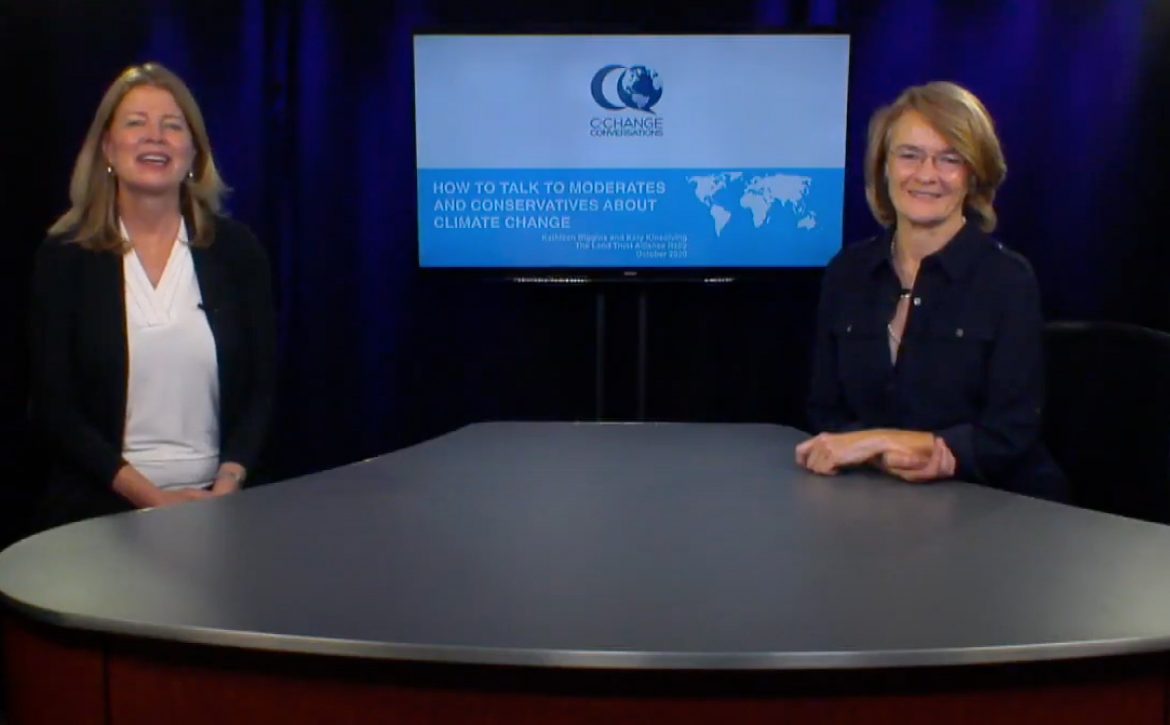
C-Change returned to a national stage on October 6th with Kathleen Biggins and C-Change co-founder Katy Kinsolving speaking during “Rally 2020,” the annual conference of the Land Trust Alliance. More than 3,600 land conservation trustees and practitioners virtually attended the 3-day conference that examined issues critical to the future of land conservation. Kathleen and Katy presented “How to Talk to Moderates and Conservatives about Climate Change” to an audience of 500. Their talk featured excerpts of the C-Change Primer presentation and examined how land preservation and use, and agricultural practices, can mitigate climate change. After the taped presentation, Kathleen and Katy fielded questions from the audience. You can watch the presentation here.

In her introduction to the presentation, Lisa Ott, President of the North Shore Land Alliance in Oyster Bay, New York and a member of the Garden Club of America, notes that C-Change Conversations team members were “just the right people to bring this message” about climate change to her colleagues and that they presented the risks and opportunities of climate change “factually … in a science-based way … and they were not threatening to the people of our community.”


New Primer Presenters Extend Our Reach
A handful of C-Change volunteers have presented the Primer to about 10,000 people in 29 states since 2018. The demand for non-partisan, science-based information about climate change spurred us to expand our ranks, and over time, we developed a robust presenter-training program that will enable us to reach even more people.

C-Change is pleased to introduce two recent graduates of the program who’ve spent many months studying, practicing, and ultimately earning the distinction of becoming trained Primer presenters. Welcome Dallas Hetherington and Nancy Ylvisaker! 


Ask a Scientist

Here are some questions we recently asked our science advisors. Be sure to check out more Q&A on our website and submit your questions here.


Bernadette Woods Placky, Climate Central’s Chief Meteorologist and Climate Matters Program Director

How is climate change impacting hurricanes now and what’s expected in the future?

Hurricanes get their strength from warm water, and those waters are getting warmer.

Scientific research shows that more of the hurricanes forming these days are rising to the level of a major hurricane – category 3-5 on the Saffir-Simpson scale. And more storms are rapidly intensifying – when storms go through an explosive growth period of 35 mph in 24 hours. This is particularly dangerous when it happens close to landfall, limiting time for proper preparations. When storms do make landfall, they are more damaging due to more heavy rain and higher storm surges that push farther inland.


Nadir Jeevanjee, Princeton University

What argument is used by the 3% of scientists who don’t agree that climate change is happening/human-caused?

My impression is that this “3%” generally consists of scientists who acknowledge that COis rising due to human activities, and who also acknowledge that this rising  CO will cause some global warming, but who disagree on the amount of warming it will cause. These scientists might be suspicious of estimates from computer climate models due to their complexity, and may have other explanations for some of the warming we’ve observed so far, such as natural fluctuations. Such skepticism and formulation of alternative hypotheses is natural, and is moreover an essential part of a healthy scientific enterprise. But the accumulated evidence, as documented in ever-expanding reports by the IPCC  and other bodies, continues to point to human-emitted CO2 as the main driver of observed climate changes.


Liz Sikes, Rutgers University

What factors triggered the end of the last ice age?

We believe that the fundamental trigger for the end of the last ice age was increasing insolation (more heating from the sun) over the northern hemisphere, where the main glacial ice cap sat. Increasing insolation happens as the earth’s orbit changes shape naturally – sometimes a component of this is referred to as the “wobble of the poles.”  These changes have timescales of about 20,000 and 40,000 years and have a slow-paced influence on climate. These shifts in solar radiation can initiate carbon feedback loops, which causes more rapid changes within the climate system. Scientific evidence shows that as the increased solar radiation warmed the oceans, circulation patterns changed and CO2 that had been sequestered in the deep ocean was released into the atmosphere. These increased CO2 levels heated the atmosphere up further and were an important driver in the last deglaciation, the ice loss that ended the last ice age. We are seeing the same thing happening today. As we raise CO2 levels through our greenhouse gas emissions, we are seeing increased deglaciation in our polar regions.

“I have had such good fortune in experiencing the profound beauty of our world, and learning how critically reliant we are on the health of our planet.  I want to address these issues for the sake of my children and all future generations – and for the sake of our imperiled earth.”

Nancy’s career has spanned investment banking, community development, and non-profit management. She spent 15 years with JP Morgan and Merrill Lynch in New York as an investment banker and then as head of their Community Development Corporations. After moving to St. Louis, she headed Bellefontaine, a non-profit historic cemetery and arboretum. Nancy is the board chair for the Nature Conservancy in Missouri and serves on the board of the Harris World Ecology Center,  the Conservation Mission Council of the Missouri Botanical Garden, the Finance Committee of the Garden Club of America. Nancy also is starting a C-Change team in St. Louis. She recently completed a post-graduate program at Yale in Financing and Deploying Clean Energy.

Read More
climatechange

Why Conservatives Should Care about Climate Change

Conservatives widely believe that blessings flow from accountability and that havoc results from lack of accountability. We’re people who believe in individual effort and reward and in meritocracies. A remnant of actual conservatives within the GOP still believes in thrift and balanced budgets, free markets, and free enterprise.

Read More
sept-2020

September 2020 Climate Change News

Sometimes it is difficult not to get depressed. On the surface, this election cycle has laid bare that the polarization around climate change created in the early 2000’s continues to divide us at a time when we must come together to stay safe. But delve deeper and there are glimmers of hope.
 
More Americans, including conservatives, say they believe climate change is happening and that they want government action to address it. In fact, latest polls show that 65% of Americans believe climate legislation should be a key priority. And the steady drumbeat of recent devastating natural disasters, which scientists say have been exacerbated by climate change, is making the concern more visceral and immediate.
 
In addition, we’re also seeing a groundswell of alarm about climate change from businesses, investment groups, regulators, and the military. A growing contingent of sober-minded leaders find it impossible to ignore the costs of climate change. They’re calling for immediate action to protect our economy, our homes, and our national security against systemic risk. Among these leaders is H. R. McMaster, a three star General who was President Trump’s National Security Advisor for 13 months and who considers climate change a top security threat to our nation and the world. 
 
If you’re a returning reader, thank you for revisiting this newsletter and please let us know how we can improve upon it. Our format presents a sampling of non-partisan news grouped in two moods: hope and concern. As we all know, both are in large supply this election season.
 
Please let us know what you think — and please share this newsletter with others.
 
Appreciatively,
The C-Change Conversations Team

Notable Graph
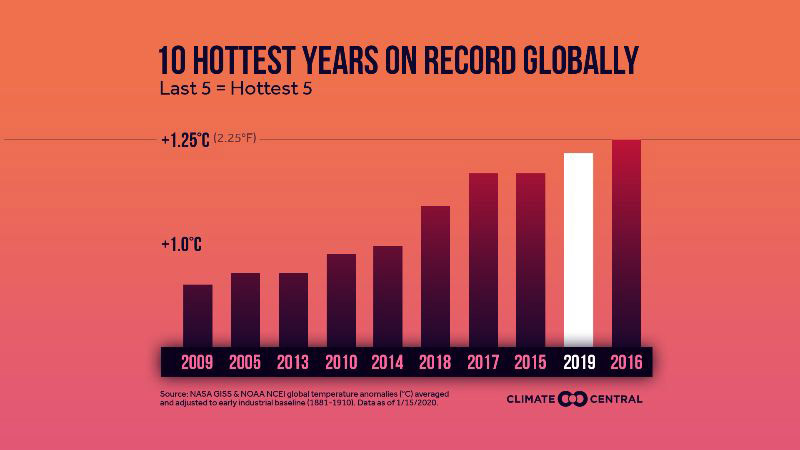
We don’t know where 2020 will end up, but it is in the running to be one of the hottest years ever.

Notable Quote

“So what should be the goal? To effectively decarbonize the U.S. and the global economies by mid-century without shock and disruption. It will be hard, but so was going to the moon.”

Rear Admiral David W. Titley, U.S. Navy, (Ret.)
(Calling for an Apollo-scale, public-private program to address climate change;
C-Change Conversations speaker, 2016)

News of Hope
Even the highly polarized U.S. Senate has found some common ground. Senate Republicans and Democrats joined forces earlier in September to cut the use of hydrofluorocarbons — refrigerants that are considered ‘super greenhouse gases’ and among the most powerful drivers of climate change.

The Commodity Futures Trading Commission released a seminal report concluding that “climate change poses a major risk to the stability of the U.S. financial system and to its ability to sustain the American economy.” The report proposes 53 climate change solutions, including a price on carbon and a Securities and Exchange Commission mandate for companies to fully disclose climate risk. Bob Litterman, who spoke at a 2017 C-Change Conversations event, chaired the subcommittee that produced the report. The subcommittee was made up of diverse interests like Morgan Stanley, ConocoPhillips, and the Environmental Defense Fund.
 
The Business Roundtable, a business lobbying group composed of CEOs from more than 200 of the largest US corporations, now supports market-based carbon pricing to fight climate change.
 
And an investing group managing more than $47 trillion in collective assets has ratcheted up pressure for net zero emissions among companies it holds. Led by investment giants like BlackRock and PIMCO, Climate Action 100+ sent a letter this month advising companies to set concrete objectives to reduce emissions by 45% within 10 years to try to meet the 1.5℃ goal set at the Paris Agreement.

News of Concern
National Geographic says that science has “incontrovertibly shown that historic fires like those raging across the American West have everything to do with climate change. In California alone, more than 3 million acres have burned so far. And fire season is just beginning. The LA Times aptly describes this year as The worst fire season ever. Again.” And record-setting fires also bring record-setting health threats. Washington, Oregon, and California suffered “the worst air quality on earth” this month due to the fires.
 
Fires aren’t the only climate-related disaster the West had to endure in September. CBS News described a simultaneous heat wave of “insane” and “unprecedented” levels with temperatures “never before seen in modern history.”
 
Meanwhile, scientists report that rising sea levels caused by melting ice sheets in Greenland and Antarctica are in sync with the ‘worst case scenarios’ projected by the Intergovernmental Panel on Climate Change.
 
Despite it all, the federal government remains dangerously out of step with the scientific consensus. So much so that six former directors of the Environmental Protection Agency from both Republican and Democratic administrations issued an appeal this month for an agency ‘reset’ after the election. They were endorsing hundreds of pages of recommendations by a bipartisan group of more than 500 former EPA senior managers and employees.

Read More
notjustanothercause

Climate Change is Not Just Another Cause

A Star Ledger op-ed by Kathleen Biggins, founder of C-Change Conversations.

Read More
aug-2020

August 2020 Climate Change News

What a month … The California wildfires. The Iowa derecho. And now, Hurricane Laura. Back-to-back, high intensity natural disasters are exactly what we’ve been warned about and are harder to respond to due to the pandemic. Each is a sobering reminder why C-Change Conversations makes it a priority to understand and discuss climate change and demand more from our elected officials at all levels to address it.

To assist in that effort, we offer this month’s curated list of non-partisan articles that focus on important developments in the story of global warming.

You may be struck, as we are, by the sense that the issue of climate change is gathering velocity on all fronts. The stories shared below describe acceleration in the speed of planetary warming and in the impacts that warming is having on people, businesses, and ecosystems. At the same time, the stories also suggest acceleration in humanity’s response to those challenges — even amid the overshadowing immediacy of the COVID pandemic.

As we did last month, we’re offering you this collection in two groups: developments that inspire hope and those that cause concern. You will find an equal number of both — but we look forward to the day when the balance tips toward optimism.  

We welcome your feedback and invite you to share this newsletter with others.
 
With gratitude for your support and interest,
The C-Change Conversations Team

Notable Quote
“Don’t live in your own echo chamber. A lot of the polarization starts with us. And it’s because we’ve been afraid to engage with people with whom we don’t agree … I tell my students this all the time, ‘If you constantly find yourself in the company of people who say “amen” to whatever you say, find different company.'”

— Condoleezza Rice
Former U.S. Secretary of State
Faculty Member, Stanford University

News of Hope
A substantial majority of Americans think the government should do more about climate, according to a Pew Research Center report …

And a MacArthur “Genius Grant” winner makes a convincing case that the transition to a low carbon economy now could supercharge the economy for the future. 

Fossil fuel companies wonder about exploring for new oil and whether even tapping known fields makes business sense. 

And BP announced that it is radically cutting back its oil and gas business and basically rethinking its business model.

There’s good news in bad: COVID-19 hasn’t caused the financial sector to backpedal its climate focus. Instead, there’s evidence that the pandemic may be galvanizing money managers to be more proactive on the crisis. And …

One large investor group just launched the world’s first step-by-step plan to help pension funds and others align their portfolios to bring us to net zero emissions by 2050.

News of Concern
The Environmental Protection Agency issued a methane regulation rollback unpopular with fuel companies,  climate scientists, Wall Street, and public opinion …

While at the same time, projections for planetary heating are getting worse.

As if on cue, California’s Death Valley hit an unfathomable 130 degrees earlier this month, and Baghdad’s temperatures were close to that a few weeks before. The descriptions and images of the Iraqi experience are breathtaking.

Some 19% of the world might face hot zones with similarly uninhabitable temperature peaks by 2070, fueling massive waves of human migrations that some say have already begun …

And experts believe even the Earth’s more temperate zones will be facing the overwhelming challenge of overlapping crises on an ongoing, rolling basis.

Notable Graph
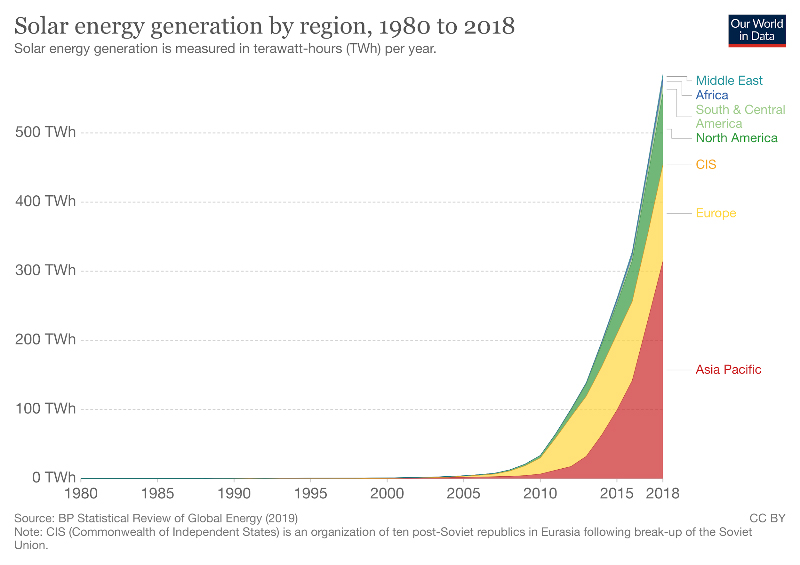
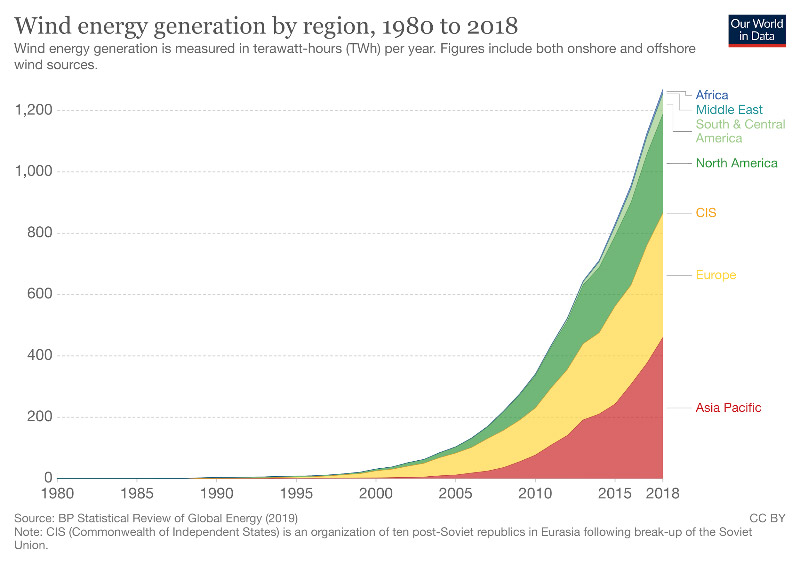
CHARTING PROGRESS IN RENEWABLE ENERGY

To end on an optimistic note, the amount of solar energy generated around the world, led by Asia and the Pacific, has grown exponentially in the last 20 years. Wind generation shows a similarly sharp upward curve, with Europe and the United States generating a larger proportion.

Read More
kathleen

Trust Your Instincts

Kathleen Biggins, founder of C-Change Conversations, interviews with Penny Bauder, founder of Green Kid Crafts.

Read More
Screen Shot 2020-11-05 at 1.25.45 PM

July 2020 Newsletter

We live in interesting times (an understatement!). Our sense of security has been shattered by the COVID-19 crisis and our sense of identity challenged by George Floyd’s killing and the ensuing reflection of who we are as a nation and as individuals. We are emotionally spent.

And yet, exhausted as we are, we need to keep in mind another challenge, climate change. Its threat may feel less immediate, but its consequences are much longer term. Scientists warn we need to act now, or our current emissions path will create a dangerous and dystopian world – one with devastating heat waves, food deprivation, more droughts and floods, and more exposure to disease. Because of our inaction so far, we are on track to leave our children and grandchildren a world we would never accept for ourselves.

Before COVID-19 emerged, the momentum on climate change had shifted. Republican leaders, recognizing that younger Republicans and independents care deeply about the issue, were finally talking about solutions like planting trees, investing in carbon capture and new nuclear power technologies. Democrats were fleshing out different approaches to a “Green New Deal.”

Business leaders like BlackRock CEO Larry Fink warned that climate change has become the defining factor in companies’ long term prospects and that it would fundamentally reshape finance. Climate change was being discussed much more frequently in board rooms, shareholder meetings, and on earnings calls. Jobs in the clean-tech sector were booming. In fact, according to the Bureau of Labor Statistics, the fastest growing jobs in 2018 were in wind and solar.

Today much of that momentum has been lost as the world wrestles with the COVID-19 crisis. Some countries are using their stimulus packages to pivot to the future – building green infrastructure and jobs. Others are simply trying to restore the status quo. We are at a critical inflection point, and how we, as individuals, nations, and a global society, choose to act will have important ramifications for our future.

And C-Change is still at work and has helped nearly 10,000 people understand the risks of climate change with our award-winning Primer. We are energized to reach an even larger audience when we look back on the great reception and positive news coverage we received for Primer presentations in Shreveport, LA and to the World Affairs Council in Hilton Head, SC.

During the COVID lockdown we continue to educate others remotely with our Primer video (followed by a live Q&A session) and webcasts. We are also working to expand our website and to deliver more climate information and analysis to our supporters. Please let us know if you want to help by inviting us to send our video or present virtually to clubs, schools, or associations in your community. Be well and stay safe.

Warmly,
Kathleen Biggins, Founder and President

Why Businesses Need to Lead on Climate Change
Pre-COVID, Kathleen interviewed Andrew Winston — a noted author and advisor to multinational companies — in the Princeton Public TV station. They had a fascinating discussion about why it is in businesses’ best interest to aggressively move to reduce climate risks — for their own bottom line and for the rest of society. Watch the interview here. 

Tips for Taking Action

  1. This week, resolve to have one conversation about climate change. Next month, have two. This video will inspire you to take that first step.
  2. Consider buying an electric car. This climate-friendly car guide from Climate Central will help you figure out which one might be right for you.
  3. Try Meatless Mondays. Cutting back on animal products from a quarter to half can make each of our carbon footprints a lot smaller.

C-Change in the News

  • Venture capitalist and climate change leader Scott Amyx interviewed C-Change founder Kathleen Biggins for his podcast. Watch the interview here.
  • Idea Mensch is an interview platform for entrepreneurs, makers, and doers. Read the interview with Kathleen.

Upcoming Events
C-Change is rescheduling in-person events with webcasts where possible. Let us know if you’d like to arrange a Primer presentation with your business group, club, church, or school.  

Tentative upcoming events include presentations to the Southampton, NY Garden Club, Jackson Hole, WY Thursday Roundtable, and the Young Presidents Organization. The Land Trust Alliance has confirmed our spot on the schedule for its October annual conference, Rally 2020.

Read More
Sign Up for News!