
March 2026
Dear Friends,
March is famous for coming in like a lion and going out like a lamb, but this year, it seems we got the whole menagerie. On the heels of a winter of extremes that wreaked havoc on economies all across the country, March was in a category by itself, with a heatwave of such intensity, severity, and geographical reach that more than 1,500 daily heat records were shattered. Some meteorologists went so far as to say it was without precedent.
What’s making our weather so fickle and dangerous?
The World Meteorological Organization (WMO) 2025 State of the Global Climate gives a clear clue to what is going on:
Humans are throwing the Earth’s energy balance out of whack.
In the past, much more of the energy coming from the sun and hitting the Earth’s surface bounced back out to space. But now that humans have added many more greenhouse gases to our atmosphere through activities like burning fossil fuels, more energy is trapped by our atmosphere and less rebounds out to space. This excess energy is stored as heat in our oceans, atmosphere, and land, creating dangerous weather patterns like more extreme drought, wildfires, rainstorms, hailstorms, and hurricanes.
The amount of excess heat the Earth absorbed last year is absolutely mind-bending. Our oceans do the heavy lifting, absorbing about 90% of that excess. Experts have tried to help us understand the vast quantities of energy involved by contrasting the energy absorbed by our oceans with the energy created when the Hiroshima nuclear bomb exploded. Professor John Abraham of the University of Minnesota notes that the amount of energy the ocean absorbed in 2025 alone is about the same as the energy from 12 Hiroshima bombs exploding every second, or the equivalent energy of 365 million bombs exploding every year.
And as this overabundance of greenhouse gases hurtles us rapidly toward a 2°C (3.6°F) temperature increase, we know the impacts of this increasing energy imbalance will only get more dangerous.
So, what do we do?
Wean off fossil fuels as fast as is feasible. Invest in new technologies and processes that can power our economy more safely, or that can absorb and lock away some of this excess energy. Support scientific inquiry. Break the old energy paradigm and create something new.
Fortunately, we’re already doing that. The transition is happening all around the world. It’s just not happening fast enough. And that is going to hurt us.
It is no longer just about doing the “right thing” for the planet. As March’s wacky weather clearly shows, it is now about doing the right thing for our own safety and financial security. So, let’s shake off our torpor and get cracking. We all need to speed up this transition to put the world back in better balance.
Sincerely,
Kathleen Biggins
Founder and President
Notable Quote
“The State of the Global Climate is in a state of emergency. Planet Earth is being pushed beyond its limits. Every key climate indicator is flashing red. Humanity has just endured the 11 hottest years on record. When history repeats itself 11 times, it is no longer a coincidence. It is a call to act.”
– UN Secretary-General António Guterres, WMO 2025 State of the Global Climate report
News of Concern
It may be near impossible to wrap our minds around the sheer quantity of heat we’re absorbing, but this fact is plain as day: in the past 10 years, our planet has warmed faster than in any decade on record. And we’re feeling that heat – the number of hours when it’s too hot outside for even the healthiest of us to do simple activities (walking the dog, for example) has doubled since 1950.
In other news this month, we were concerned to learn:
- In March, wildfires tore through Nebraska, South Dakota, and Wyoming – unexpected areas for such blazes. Experts fear this heralds an “expanding frontier” for fire risk – with more communities in harm’s way – as well as a ferocious season this year.
- The conflict in the Middle East is driving emissions up in the short term, as countries have burned off (or flared) higher volumes of natural gas as infrastructure is shut down or damaged. At the same time, many countries have turned back toward coal as imported natural gas costs soar. But there is hope that in the longer term, this conflict will speed adoption of clean energy, as more countries begin to view energy sovereignty – the ability to create energy in one’s own country – as the key to energy security.
- Insurance premiums continue to ratchet up at a pace faster than inflation or incomes – and it’s hitting Americans no matter where we live, even if it’s not in a place prone to hurricanes, wildfires, or other extreme weather events. Our insurance system wasn’t designed to handle the extreme costs of climate change, so expect a lot of disruption (and continued price jumps) ahead.
- Higher levels of carbon dioxide in the air from climate change are impacting our blood chemistry. Humans evolved when atmospheric CO2 levels were around 300 parts per million (ppm). Now levels are over 420 ppm. Breathing in those higher levels is making our bodies more acidic, and experts aren’t sure how future generations will fare.
- After the courts overturned the Trump administration’s efforts to shut down offshore wind projects, the administration launched a new strategy – paying developers to abandon offshore wind leases and invest in oil and gas instead. The recent $1B payout to French energy giant TotalEnergies led it to abandon wind farm leases that could have powered more than a million homes in New York and North Carolina.
News of Hope
We talk a lot about how China’s energy transition has left the U.S. in the dirt. But we have a major win to report – the U.S. now has the capacity to produce enough batteries to meet 100% of the surging energy storage demand on our grid. It’s been called “one of the fastest industrial scale-ups in recent American history,” and illustrates the power of our domestic manufacturing when it has strong policy support. Batteries are critically important for a wide range of grid services, from meeting AI electricity demand peaks to expanding renewable energy use.

Derek Otway/Unsplash
We have an unexpected ally in fighting climate change – a new study shows that beavers are creating mighty carbon sinks when they dam up springs. Thanks to conservation efforts, beavers are flourishing across Europe, and their activity is creating healthy wetlands that absorb and lock away emissions.
More optimistic news this month:
- With weather growing wilder and weirder, we’re thankful that FEMA is back in action to help our communities become more resilient and prepare for nature’s new “normal.”
- About a million New York City households will benefit from clean power when a massive hydropower line spanning from Quebec to Queens comes online. This will be the longest buried transmission line in North America and is considered an engineering feat.
- As the globe reels from the conflict in the Middle East, countries that are already transitioning to clean energy are coping better with the blow. From Germany to Nigeria to Pakistan, booms in solar and other renewables are buffering economies from some of the sting of price increases and volatility in supply chains.
- Excitement around new forms of geothermal energy, which can provide 24/7 clean electricity and heat, continues to build, with the U.S. Department of Energy saying geothermal could potentially provide close to 9% of all our power by 2050 – up from only .2% today. This is one of the few clean technologies that garners bipartisan support – and it offers an almost seamless transition for oil and gas workers as their skills mesh with the needs of this growing field.
C-Change has been breaking the silence around climate change for more than 10 years – and this year, Hollywood is, too. Almost a third of the 2026 Oscar-nominated films mentioned climate change. Turning a spotlight on the issue by including it in modern culture can help more people recognize the problem, understand the risks, and (we hope) start talking louder about the need for climate action.
Notable Graph
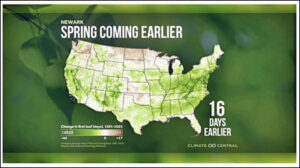
As March rushed in with its wacky weather, spring sprung up earlier than ever. According to Climate Central, spring leaves are emerging six days earlier in 88% of U.S. cities. And while these signs of spring do bring joy, they also bring longer pollen periods, disrupted animal migratory patterns, and concerns for our crops.
Notable Video
In this PBS report, Climate Central’s Bernadette Woods Placky explains why the March heat dome was so remarkable. She breaks down the ramifications of those high temperatures, from the effect on our summer water supply to our increased wildfire risk and more.