JUNE 2026
At a time when the world’s climate systems are flashing red, many Americans seem to be responding with a shrug – or with willful avoidance of the topic. Media climate desks have been disbanded, liberal politicians have dropped the issue, consumers are understandably focused on soaring energy costs, and the federal government is pretending climate change doesn’t exist and perversely boosting coal (the most expensive and carbon intensive fuel of all). It’s like we are collectively reverting to childhood, shutting our eyes so the boogeyman can’t get us.
But, unfortunately, closing our eyes doesn’t mean the boogeyman isn’t coming – and this one is coming with a vengeance. So far this year, temperatures are trending higher (France just hit its hottest day ever recorded), early wildfires are more widespread and destructive, and water supplies are at record lows). And the
extremes – heat, drought, and, conversely, excessive rain – are bedeviling farmers and endangering food supplies.
And remember, our climate woes today will look like child’s play tomorrow. To get a sense of what we may be setting into motion, let’s look at conditions the last time emissions were this high: three million years ago, when temperatures were 4.5-7.4°F hotter than our pre-industrial temperatures and oceans were at least 16 feet higher with large parts of the Atlantic coast, the Carolinas, and Florida under water.
The good news is that despite this environment of “climate malaise,” more Americans than ever are worried about climate change and a strong majority – 63% in a recent Gallup poll – want our government to do more about it. Companies, including American icons like GM, are reimagining how our energy systems will run in the future. Investors are piling into cleantech, with global investments hitting $2T in 2025, more than double investment in fossil fuels. And electrification – using electricity for transport, industry, heating, and power – is advancing globally at a blistering pace and is three times more efficient than using fossil fuels for most of the same tasks.
So, let’s shake off our malaise and get cracking. Let’s open our eyes to what’s happening, so we can understand both the real risk of climate change and the promise of the innovation around us. The only way to chase that boogeyman away is to meet him head on.
Sincerely,
Kathleen Biggins
Founder and President
Notable Quote
“The current El Niño is … riding on top of a substantial amount of global warming. This means that the actual temperatures in affected regions could well be unprecedented, as the warming from El Niño is being topped up by climate change.” – Adam Scaife, a climate scientist at the U.K.’s national weather service
News of Concern
El Niño has officially arrived – and the likelihood that it will become a rare “super” El Niño is looking more and more likely. El Niño is a Pacific weather pattern that affects the whole globe, increasing temperatures and causing extremes in both rainfall and drought. This El Niño is beginning when our oceans are already 0.9°F warmer than normal and forecasters believe there’s a high chance that sea surface temperature rise will exceed 3.6°F this year. That means more storms in the southern U.S., hotter weather in the Pacific Northwest, and less snow in Canada – all of which will impact our weather and our economy.
In other concerning news we’re watching:
■ Natural gas flares – the gas burned off during processing – rose to the highest level since 2019. The U.S. is among the top producers of flares, which pump carbon into the atmosphere and contribute to global warming.
■ According to a new report from the United Nations, the amount of electricity gobbled up by data centers around the world might be equal to that of the sixth-largest power-consuming country by 2030.
■ At a time when electricity demand is skyrocketing, the Trump administration continues to cancel wind projects. But we are encouraged by one energy development company that took the payout – Invenergy said it will use that money to invest in next-gen geothermal development.
■ We’ve talked a lot about how climate change is coming for the things we value – and now our beloved tomatoes (and all of the products they’re in, like ketchup and sauce) are on that list as drought and heat impact crops around the world.
News of Hope
It’s a welcome sign that renewable energy is getting big enough and politically savvy enough to start challenging candidates who are vehemently against clean energy. Stealing a page from the fossil fuel industry, a new PAC is supporting Republicans who may not be full-throated supporters of renewable energy, but who are more moderate than their opponents. In other words, the PAC is retaliating against those who are gunning for the renewables industry and is aimed at making clean-energy support important on both sides of the aisle.

Here’s some good news for our coral reefs: a new study has identified more than 5,800 square miles of ocean where local conditions will slow climate change’s impact and allow some coral to survive longer. Coral reefs, which are bleaching at a rapid rate due to rising sea temperatures, are crucial to the health of the ocean and to our economy.
And there was more good news in June:
■ The Trump administration announced a $17.5 billion loan for building large nuclear reactors, with the hope they can be built faster than in the past and come online by the mid-2030s. The driving force behind the funding is to provide more power for data centers, but utility and energy companies should also benefit from an influx of clean power on the grid.
■ The data center buildout is increasing support for novel approaches to add grid flexibility and meet higher peak power demands. Sunrun, Tesla, and Renew Home – the top providers of rooftop solar, home batteries, and smart thermostats in the U.S. – are teaming up to create a massive virtual power plant (a network of home-based smart thermostats, EV chargers, smart appliances, and home batteries) that are contracted to send power back to the grid when needed. Harnessing this “distributed power” (aka power in our homes) more widely could result in $10B in savings to U.S. utility customers annually and can provide new energy resources more quickly than building new plants.
■ Seven Northeast states are suing the Trump administration for paying TotalEnergies $1B to scrap offshore wind projects. States claim the administration’s move will squander billions already spent in economic investments, raise electricity costs, and kill thousands of green-energy jobs. Their goal is to strike down the administration’s agreement for canceling the offshore leases.
■ One of the biggest challenges of climate change is how it is impacting our water
supplies – in many cases, higher temperatures and evaporation levels are leading to less water for farms, energy production, and people. California is expanding a pilot program to put solar panels above irrigation canals that can both generate significant amounts of clean energy and save billions of gallons of water by protecting the canals from evaporation.
Notable Graph
For the first month ever, wind and solar generated more electricity than gas globally in April. Part of this is due to gas disruption from the Iranian war but the shift may be more permanent than many people think, as countries move toward clean-energy sources that are cheaper and more secure. For contrast, just five years ago, natural gas provided almost twice as much electricity as wind and solar, indicating how rapidly renewable energy is shaping the power mix worldwide.
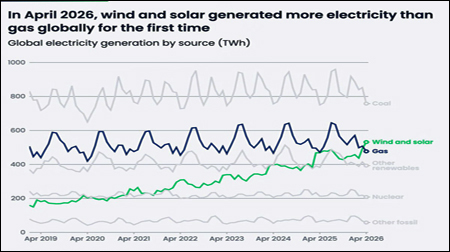
Source: Monthly electricity data, Ember. “Other renewables” includes hydro, bioenergy, and smaller generators such as geothermal. “Other fossils” includes oil and other fossil generators
Notable Video
As summer settles in, so does the humidity for much of the country. The number of dangerous humid heat days has more than doubled since the 1970s – and is affecting more locales than ever – increasing our risk of heat-related health issues like heat stroke and heart attacks. Climate Central explains why humid heat is so dangerous.