B-Change Blog: Reducing Food Waste Helps the Climate



by Karen Dougherty
Here’s a fact that may surprise you: the global fashion industry is a leading contributor to climate change. And because people don’t often make the connection between their shopping habits and rising temperatures, it’s a sneaky culprit.
Our point isn’t to make you feel guilty about shopping – but the more we know about the causes of climate change, the easier it is for us to make behavioral choices. Every single item we buy has to be produced, packaged, and shipped, either to us as individual consumers or to a store. Each step along the way uses energy and resources, emits heat-trapping gas, and creates waste. Just like with every industry, some companies are more responsible than others. The worst offenders are those making high volumes of cheap clothing in the trends of the moment, a.k.a. “fast fashion.” Mass-produced clothing is often made overseas, in locations where exploitation of workers and environmental pollution can make a bad situation worse.
The textiles themselves are also problematic. Natural fibers like cotton require a shocking amount of energy and other resources to produce, but synthetic fabrics have their own set of drawbacks. Even high-quality brands use polyester and nylon, which are made from oil and contain plastic. Synthetic fabrics shed microplastics during manufacturing and throughout the rest of their lifecycle.
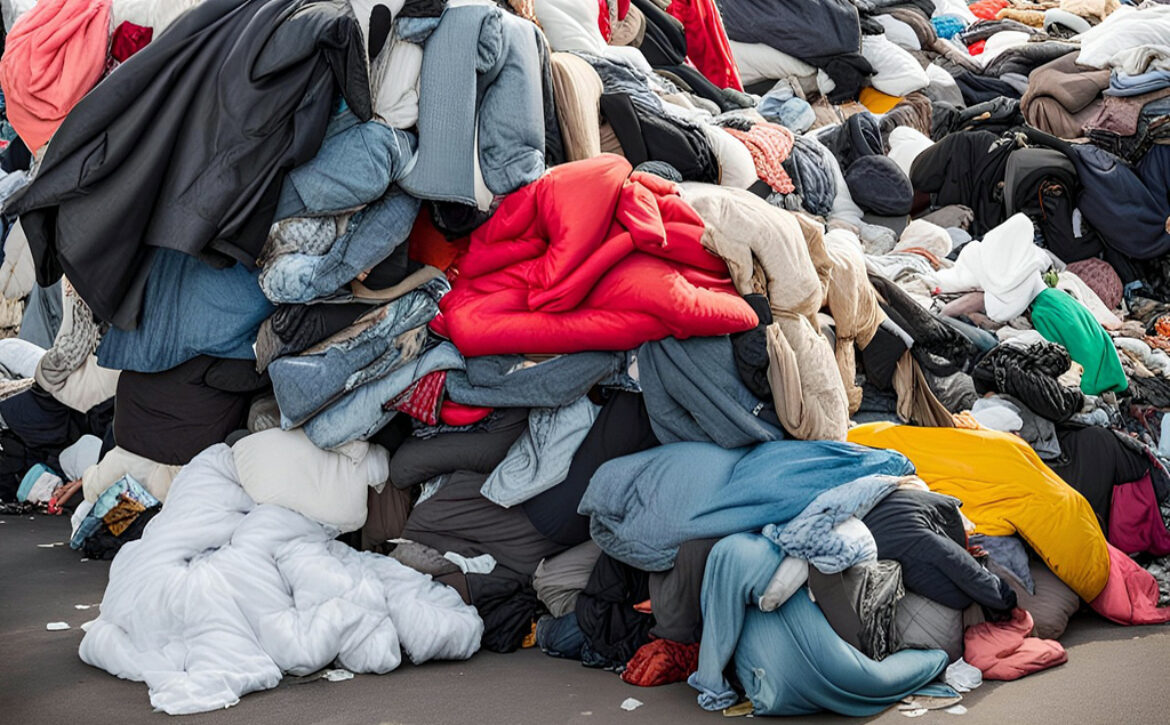
The problem continues even after we are finished wearing a piece of clothing. Sadly, donating isn’t as helpful as we think – an estimated 85% of used clothing ends up in landfills, where it releases methane, a potent heat-trapping gas. Further, because of the plastic content, it may live there forever.
Eye-popping facts about the fashion industry:
Industry-wide change is needed
In order to solve our climate problem, the industry needs to adopt system-wide change. Many companies are responding by reducing their emissions, and are using more sustainable fabrics and manufacturing processes. Some are certified as B Corps, meaning they meet a set of environmental and social governance standards. Consumer demand for these options will help force change.
An inadvertent upside of tariffs
There are new economic factors at play that may have the inadvertent effect of slowing fast fashion and overconsumption, which would ultimately reduce industry emissions. Clothing made inexpensively overseas and imported into the United States is facing new tariffs, including the closing of a key loophole that is expected to lead to higher prices and slower shipping times. This may make the trend of over-buying less appealing.
What can we do?
When it comes to clothing – or any consumer product – the formula is fairly simple: buy less, choose sustainable options, use longer, and recycle more.
Here are some clothing-specific ideas:
Consumer demand can help motivate companies to change how they operate. We can be a part of the solution by investing in fewer, more sustainably-made pieces of higher quality. It may feel like a small change, but it can really make a meaningful impact.
In addition to volunteering for C-Change, Karen blogs about climate change at unheating.com.

By Karen Dougherty
How many times a week do you typically eat beef? Did you know that dropping that number, even by one, would help solve climate change? It’s true. There is a strong relationship between meat consumption and our rising temperatures. Choosing a meatless meal is great, but even replacing steak with chicken, or ground beef with ground turkey, makes a whopping difference.
Why is there so much focus on beef? The main reasons are: methane, land, and resources. Add these together and the impact of beef consumption on heat-trapping emissions is staggering.

Source: Our World in Data
Methane
When we think of heat-trapping gas, carbon dioxide comes to mind first. Rightfully so – it is the biggest offender, and it lingers in the atmosphere for a very long time. But another major culprit is methane. Methane is especially problematic because, although it dissipates from the atmosphere faster than CO2, it has at least 25 times the heat-trapping potency. Methane is responsible for 20-30% of the temperature increases due to climate change, so decreasing its levels is one of the quickest and easiest ways to slow down warming.
Cows are a major source of methane. The unique digestive system of ruminant animals like cows, sheep, and goats is to blame. Methane is a by-product of their digestion, released into the air through their gas. With over 1.5 billion cows on the planet, the problem is immense.
There are some cool solutions being studied to reduce the amount of methane coming from cows. One fascinating example is adding seaweed to their diets. It significantly reduces methane emissions. Solutions like these are coming, but aren’t quite ready for widespread adoption.
Land
Raising animals for food requires a lot of land, and larger animals take up more space. Although it doesn’t seem like it when you fly across the Midwest, farmland is a limited resource. The more land we use for cattle, the less we have for growing crops. Massive amounts of land are also needed just to grow enough food to keep cattle fed.
Did you realize one driver of deforestation in the Amazon is to clear land for cattle? Americans have such an appetite for red meat we can’t fulfill our needs domestically, so we import from other countries, including Brazil.
Resources
In addition to needing more space, bigger animals use more resources. They eat more, drink more water, and require more energy to raise and process – and to be transported around the country or the world. Slowing our intake of beef would reduce emissions from all these sources.
Other benefits
I’m a big fan of climate solutions with multiple benefits. If we cut back on red meat consumption, there are other wins for us, namely saving money and improving our health. Beef is generally more expensive than other animal proteins, and a diet high in red meat is linked to increased rates of certain cancers, type 2 diabetes, and heart disease.
Nobody is going to force us to stop eating beef, but if we choose to make even small changes to our consumption, it could be a win-win for our health, our budgets, and our climate.
In addition to volunteering for C-Change, Karen blogs about climate change at unheating.com.

