What Would Happen if AMOC Collapsed Completely?
By Michael Mann
Climatologist and geophysicist Michael Mann is a presidential distinguished professor in the department of Earth and Environmental Science at the University of Pennsylvania and the director of the Penn Center for Science, Sustainability, and the Media. Dr. Mann received his M.S. degree in physics from Yale University, and a Ph.D. in geology & geophysics from Yale University. His research interests include the study of Earth’s climate system and the science, impacts, and policy implications of human-caused climate change. He is author of more than 200 peer-reviewed and edited publications, numerous op-eds and commentaries, and six books.
Question:
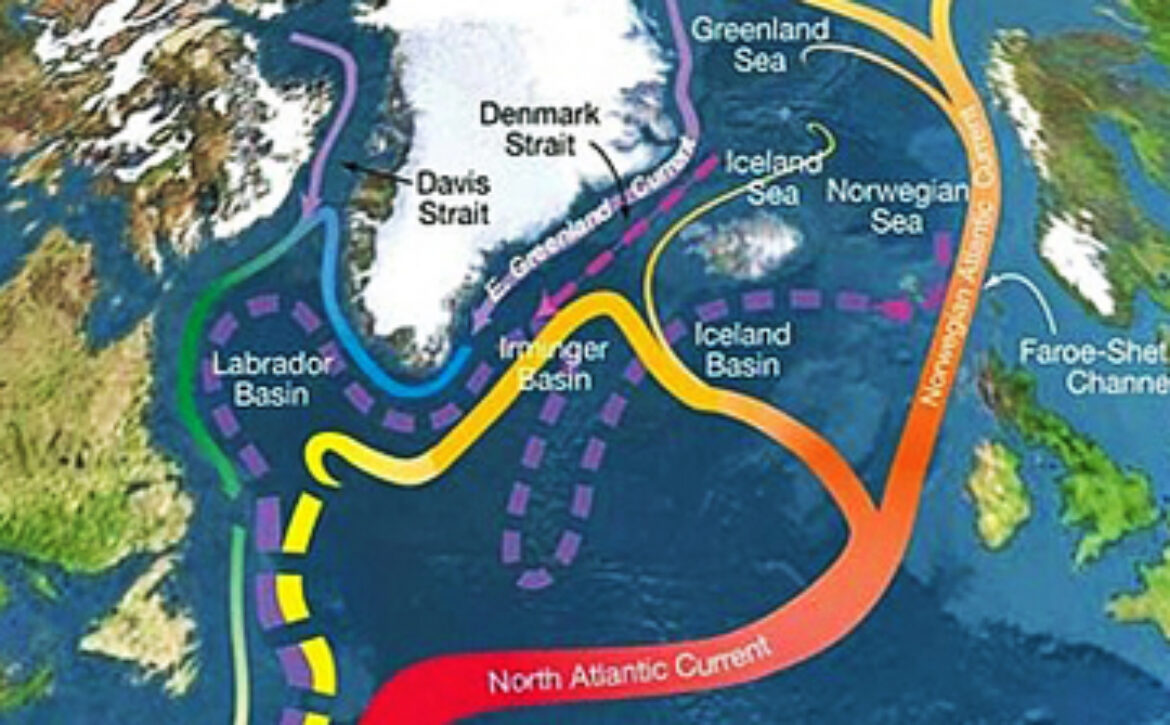
What happens if AMOC [Atlantic Meridional Overturning Circulation] collapsed completely, happened suddenly, and circulation stopped completely and the ocean cooled to full potential. From a physics point of view, if energy is not transferred by the ocean, it builds up and should be transferred somehow, perhaps using the atmosphere.
Answer:
The short answer is that a slowdown, or possible collapse, of the AMOC would not have the dramatic impacts that are depicted in popular movies and renditions (e.g. “Day After Tomorrow”). There would probably be cooling of the sea surface temperatures in the subpolar North Atlantic (including Iceland), but simply less warming in eastern North America and western Europe – as it would offset some of the more globally pervasive warming regionally.
There would be less ocean mixing in parts of the North Atlantic and decreased marine productivity (which would be very bad for global fish stocks), increased sea level rise along parts of Mid-Atlantic coast, and regional changes in atmospheric circulation that could lead to more warming in some places and cooling in others.
The question is on target in that there is a tendency for compensation. If you slow down the current and get cooling up north, you increase the sea surface temperature gradient between the mid-latitudes and pole, increasing mid-latitude storm activity, which transports more heat poleward in an attempt to even out the gradient.