OCTOBER 2026
Worrying about climate and AI
isn’t crazy. It’s smart.
By Kathleen Biggins
The White House recently suggested that the same “hysterical” people who care about climate change are the ones concerned about the rapid buildout of artificial intelligence. The administration might be onto something.
Not because the AI buildout is driving up emissions – although that is a growing concern. One recent report estimates that the increase in U.S. emissions associated with gas-powered AI and data centers over the next three years could equal Mexico’s entire current annual emissions. Nor is it simply because AI infrastructure can create environmental problems, including air, heat, and noise pollution.
And certainly not because those of us concerned about both issues are simply “Luddites” who shun all technological progress.
It is because climate change and AI share some striking similarities that may not be apparent at first glance.
Climate change is primarily driven by carbon pollution from burning fossil fuels. These fuels have powered the development of our modern world, bringing prosperity and a high quality of life to billions of people. But the very technology that helped build our civilization is now destabilizing the natural systems on which we depend. We are setting in motion changes that, once unleashed, could be impossible to reverse within human timescales.
We have known for decades that burning fossil fuels would harm our planet. President Lyndon B. Johnson was briefed on the dangers of rising carbon dioxide levels in the 1960s. Yet we failed to develop the policies and technologies needed to safely manage our dependence on fossil fuels. Had we acted earlier, we could have avoided much of the damage we are now facing.
The short-term benefits were simply too seductive. Fossil fuels created enormous wealth and prosperity, while the consequences of their use seemed distant and abstract. But now the bill is coming due.
Climate change is already imposing substantial economic costs, from destructive storms and wildfires to rising insurance premiums and damage to infrastructure. The projected losses are staggering. Experts warn that climate-driven insurance costs could make homes, businesses, and long-term investments increasingly difficult to insure at affordable rates. This could put pressure on mortgage lending and banking, creating cascading effects throughout the economy.
And the consequences extend far beyond financial losses. Rising temperatures could make some regions of the world increasingly difficult, or even impossible, for humans and other species to inhabit. Climate change could also intensify competition over dwindling resources, increase migration, and heighten the risks of conflict.
Now consider artificial intelligence.
AI, too, promises enormous benefits and wealth creation. It could transform medicine, scientific research, education, and countless other aspects of our lives. But some of the very experts developing this technology warn that it could also create risks we may struggle to control.
Some fear that increasingly capable AI systems could improve themselves so rapidly that humans lose the ability to manage them. Others warn that AI could make it easier to develop dangerous weapons or enable malicious countries or groups to cause widespread harm.
There is another risk that may be less dramatic than the prospect of AI escaping human control but could be just as consequential: the disruption of our already fragile social fabric.
AI is already displacing humans within the work force and will continue to outperform us in an ever-growing range of tasks. Our prevailing social paradigm values education, expertise, creativity, and hard work. Our work has been an important part of our identity and a guiding tenet of how we organize our days and lives. By replacing or diminishing our value within the workforce and society, AI could foreseeably lead not just to widespread economic disruption but to a deepening social crisis.
The details of these risks are different from those posed by climate change. But the underlying challenge is remarkably similar.
In both cases, we are developing powerful technologies that deliver enormous benefits today while potentially creating risks that could be catastrophic tomorrow. The people and industries benefiting from these technologies have strong incentives to keep advancing them. And the consequences of getting things wrong may not become apparent until it is too late to prevent serious harm.
The goal is not to stop progress. It is to make sure that progress serves humanity rather than putting our future at risk. We need to create safeguards while we still can.
Climate change has taught us how costly it can be to ignore the warning signs of a powerful technology. We should not make the same mistake twice.

A podcast episode we think you’ll like: “Whatever Happened to the Ozone Hole?” from Are We Doomed?
Remember the hole in the ozone layer? Today, it’s largely considered one of our biggest environmental success stories – but getting there was much messier than we remember.
This episode of Are We Doomed? goes back to how scientists discovered the problem, the political and public battles over what to do about it, and how the world ultimately came together to take action. For Simmer Down listeners, it’s a fascinating and hopeful look at what it actually takes to build consensus around a global environmental threat, and what that success might teach us about tackling climate change today.
The Big Picture
Every month, we scour the headlines to curate a mix of news that helps us understand how climate change is impacting our lives and recognize the solutions we have to address the risks. Here are some highlights from the past few weeks:
News of Concern
■ The Trump administration plans to roll back regulations requiring oil and gas companies to detect and repair methane leaks. Methane is one of the most potent greenhouse gases and cutting back leaks is considered one of the fastest ways to slow warming.
■ Most of our coral reefs – vital ecosystems for the whole planet – could collapse in the next 50 years if climate change continues on its current trajectory.
■ California, which is responsible for almost 15% of our national GDP, issued a new climate assessment report that projects a difficult future: more wildfires, bigger storms, longer droughts, vastly reduced beaches and snowpacks, and significant hits to farming and property values.
■ Texas A&M’s university system removed climate change from core curricula at public universities because it has deemed it not “foundational and fundamental” to prepare students for civic life and the workforce, even though since 1980, Texas has experienced the most weather-disaster damages of any state and is considered one of the most vulnerable states going forward.
News of Hope
■ Experts see signs that the U.S. electric vehicle market is rebounding as automakers roll out better and cheaper models and gas prices remain high.
■ Ford’s Fathom – an electric pickup due to hit markets in 2027 – doesn’t just have a low sticker price, it has technology that will allow it to act as a home battery, a real advantage as grids become more insecure.
■ Thermal storage – battery arrays that store “blistering” heat and release steam as a power source – has the potential to provide vast amounts of inexpensive clean energy.
■ A new report shows using more heat pumps to warm and cool our homes could help significantly drive down electricity costs, save emissions, and smooth out grid use in most parts of the country.
Notable Graphic
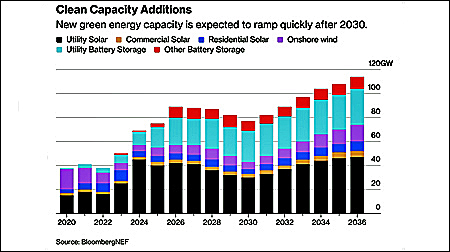
The U.S. is still installing record amounts of clean energy, with growth expected to accelerate next year and surpass natural gas capacity by September of 2027. At the same time, however, the data center surge is driving an expansion of natural gas, dampening the climate benefits from that clean-energy growth.
Notable Video
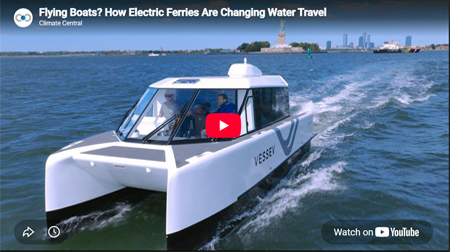
Electrify everything! It’s our climate change mantra, and it’s happening all around us. For example, electric ferries are increasingly sailing (and, in some cases, “flying”) across the water, allowing us to travel in an affordable, clean way – and a fun one, at that. This video from Climate Central gives us a great peek into this growing mode of transportation.