Dear Friends,
In September, the climate world descended on New York City for the 18th annual Climate Week. Several C-Change Conversations members attended, and we were honored to present at several events.
It was a week of contradictions.
On one hand, the U.S. energy leaders like Secretary of Energy Chris Wright promoted fossil fuels, telling us that energy security can only be obtained by investing more in these power sources. In his address to the United Nations, the president of the United States also emphasized the need to grow fossil fuel usage and reissued an old – and inaccurate – claim that the climate has not been heating up at all and has been, in fact, cooling.
But during the same timeframe, climate change was unsheathing its claws. On the Sunday of that week, during an extreme heat wave in Nashville, the astroturf reached 157°F at the Titans/Eagles football game, causing players’ cleats to melt. A few days before, a tropical depression in the Pacific morphed into a category 5 hurricane in less than 24 hours, the second-fastest intensification on record. And it’s official: July, August, and September were each the hottest ever recorded in the contiguous United States. Extreme heat and hurricane intensification are hallmarks of climate change, and September’s events are harbingers of the challenges that will worsen more in the future as climate pollution continues and temperatures rise.
The juxtaposition of these two realities indicates how challenging our situation is. According to a new U.N. study, we are now certain to miss the 1.5°C climate goal and will need to both stop emitting greenhouse gases as quickly as is feasible and remove carbon from the atmosphere on a grand scale to avoid “catastrophic” levels of warming. Yet despite the clear need for action, our political systems aren’t up to the task. Instead of supporting a disciplined transition toward cleaner tech, the U.S. is doubling down on the very products that are causing climate change – and the pain and economic loss that come with it.
We can do better. Other countries are doing better. And the good news underscored at Climate Week? Energy security comes from energy sovereignty, the ability to make and control the energy you need, while avoiding price shocks from globally traded fossil fuels. And wind, solar, and batteries can help deliver that in spades, usually at lower prices than fossil fuels. That new reality – that clean energy provides safer and more affordable energy – gives us a winning hand. We just need to start playing it.
Sincerely,
Kathleen Biggins
President and Founder
Notable Quote
“I think this summer was a summer of truth. The recent summer months have been, as we heard from the scientists, the hottest on record, but may be the coolest for the years to come.”
— Ursula von der Leyen, president of the European Commission
News of Concern
Unfortunately, as noted above, the U.S. is not recognizing that moment of truth: last month the administration repealed carbon emission limits for power plants and scaled back fuel-efficiency regulations for light trucks and new cars. Both moves will significantly drive up greenhouse gas emissions, but the fuel-economy rule is particularly bedevilling because it hampers American competitiveness in the global car market. Combustion engine cars reached their peak sales globally in 2017 and have been declining steadily since. In contrast, global sales of electric vehicles are skyrocketing – buoyed by declining battery costs and escalating gas and diesel costs – and the International Energy Agency projects they could comprise the majority of new car sales as early as the mid 2030s. Redirecting policy support from EVs to combustion engine cars in the U.S. is like doubling down on building DVD players when digital streaming was ascending – it locks us into antiquated technology.
There were many areas of concern in September:
■ The world is experiencing a “Super El Niño” at a time when climate change is already pressuring communities. In California, sea levels have risen 6-9 inches since preindustrial times, and some coastal homes were already tumbling into the sea. Now El Niño is delivering a series of Kelvin waves – pulses of water that could suddenly raise sea level an additional 6-12 inches – threatening much greater swaths of the coastline. Scientists warn the Kelvin waves give us a preview of what regular sea levels could be later in the century due to climate change.
■ Climate change is impacting water sources in other ways as well – warmer temperatures are melting glaciers and thawing permafrost, which can cause deadly flooding like the event that devastated Nepal in September. This is a growing threat across mountain regions globally.
■ This incredibly hot summer in Europe was not an outlier. Scientists expect 2027 to be just as hot, and future summers even hotter as climate change ratchets up. And in many places that means it’s getting drier as well – in fact, scientists are concerned that climate change could help make the megadrought that has plagued our Southwest permanent.
■ China may lead the world in renewable energy growth, but it’s also emitting the world’s most-potent, longest-lived greenhouse gas at an alarming rate. Sulfur hexafluoride is used in electrical circuit breakers and high-voltage equipment. China apparently vents much of it into the air when that equipment is no longer in use and in quantities that can equal the annual emission of 29 million gas-powered vehicles.
As it turns out, our brains really don’t love the heat. Scientists have found that rising air temperatures negatively impact our brain chemistry and function. To put it bluntly – extreme heat is making us dumber. However…
News of Hope
… Cleaner air makes us smarter. Studies looked at how children’s cognitive development was impacted by prenatal exposure to air pollution (a byproduct of climate change, because higher temperatures contribute to increased levels of smog). Not surprisingly, less exposure to pollutants equaled better brain function.
When we understand how climate change impacts our brains – and so many other aspects of our lives – we’re more inclined to talk about it and act to bring about solutions.
In other hopeful news:
■ The Senate is finally tackling the thorny problem of permit reform for the electricity system, including the grid and more. U.S. electricity demand and prices are soaring, in part due to AI data center expansion, but our antiquated grid can’t bring on new electricity generation fast enough. Part of the problem is that it can take decades to get approval for new power lines, and natural gas pipelines often face years of environmental litigation. The new bipartisan Senate proposal attempts to broker a way forward to increase electricity generation and control escalating costs. While we are not endorsing the specific proposal, we are excited that Congress is finally focusing on permitting reform, as it has become the “third rail” of energy politics.
■ In a huge step forward for clean energy, Fervo Energy became the first company to sell enhanced geothermal energy onto the grid. Enhanced geothermal injects fluid miles below the surface, captures the Earth’s heat, then uses it to turn turbines for electricity generation. This new approach enables geothermal energy production far beyond volcanic areas and provides carbon-free, round-the-clock energy.
■ We talk a lot about worrisome climate tipping points that will have far-reaching and irreversible impacts on the world. Fortunately, hopeful tipping points are emerging as
well – for example, solar is now the cheapest source of electricity in the world and is growing at unprecedented levels. Access to clean power enables areas like transport, heating and cooling, and manufacturing to electrify and decarbonize, creating positive economic changes while also lowering pollution levels.
■ It takes a lot of space to build a solar array, and that’s not always easy to come by in smaller countries. We loved reading that Japan is repurposing parts of its small island on a grand scale, turning its defunct golf courses into solar farms.
■ On another small island filled with apartment dwellers, charging an electric vehicle can pose a major challenge. In response, New York City is stepping up for its EV-driving residents, installing hundreds of curbside chargers to make it easier to own these nonpolluting automobiles.
■ Did you know cement making is responsible for 8% of the world’s carbon emissions? This new method could literally change the foundation of construction, drastically reducing the carbon output of cement by using an electrochemical process and renewable electricity during production.
Notable Graph
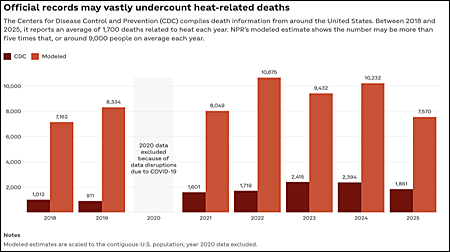
As climate change drives up our global temperatures, we’re being exposed to more extreme heat for longer periods of time – heat that even the healthiest of us can’t tolerate. And that could be many more people than you’d expect: this NPR study estimates that heat is killing five times more people in the U.S. than official CDC records show, at a rate of about 9,000 deaths per year.
Notable Video
As we said above, tipping points are those moments when a final shift occurs to create an unstoppable change on a larger scale. Experts are concerned that we are approaching such a moment with the AMOC (Atlantic Meridional Overturning Circulation). This excellent video by the Potsdam Institute for Climate Impact Research explains how the AMOC works, why experts are concerned about how climate change is disrupting it, and what that would mean for our civilization as we know it today.