
February 2026
Dear Friends,
In this time of global unrest, we are forced once again to recognize the fragility of our global fossil fuel system. The Ukrainian invasion triggered staggering oil and gas price increases, and the new Iranian conflict, depending on how long it lasts, portends to do the same.
How can we prevent these shocks to the global economy?
By developing a new, improved energy system that enables countries to create the power they need from homegrown resources.
It’s not as farfetched as you think. The world is actually already moving in that direction, driven by countries’ desire to have more energy sovereignty – the ability to create and control the energy they need and to avoid the volatility of global fossil fuel markets.
What does this new system look like?
A rapid rise in renewable technology that enables us to make electricity out of sunbeams and wind currents. Batteries that enable us to store that super-cheap energy to use more widely throughout the day. New technologies that enable our grids to be nimble and more efficient, and to transport energy from sunny and wind-swept places to population centers. A more-fluid distribution system that enables homeowners to produce or store energy in their homes and sell it back to the grid when needed.
On top of creating cleaner electricity, this new system embraces the “electrification” of other sectors of our economy – transportation, manufacturing, shipping, and home appliances – that use clean electrons instead of dirtier, more expensive, and less-efficient fossil fuel molecules.
And this new energy system is evolving faster than many Americans realize, in part because our country is trying to swim against that tide, and our rhetoric around climate and energy is so politically charged.
Let’s take a look at recent evidence in the world around us.
Last year, for the first time, the EU, the third-largest economy in the world, created more electricity from renewable sources than from fossil fuels. And while the U.S. has pulled back from offshore wind, the Europeans are doubling down. The UK and the EU recently announced the Clean Energy Security Pact, a commitment to jointly construct the world’s largest clean-energy reservoir, an immense 100 GW wind turbine network in the North Sea. Policy makers heralded the project as a way to get off the “fossil fuel rollercoaster” and increase energy security.
On the electrification front, more than a quarter of all new car sales globally are now electric, with rapid growth in developing countries offsetting a slackening demand in the United States. Chinese-manufactured EVs are now significantly cheaper than combustion engine cars, and in places like Singapore and Vietnam 40% of all new cars are electric. This trend toward EVs is accelerating, which is good news for the climate. Electric cars have already displaced more than 1 million barrels per day of oil consumption globally.
And even in the U.S., despite federal policy supporting coal and curtailing renewables, almost all new electricity generation (92%) added to the grid last year was from clean energy, and a similar amount is projected for this year. Our transition has slowed, but not stopped.
So let’s keep looking at the big picture: this evolving energy system is not just smart from a climate perspective, it’s smart from an economic and geopolitical one as well.
And at a time when the world feels like a very dangerous place, that’s something to give us hope.
Sincerely,
Kathleen Biggins
Founder and President
Notable Quote
“The U.S. no longer has emission standards of any meaning. … Nothing. Zero. Not many countries have zero.”
— Margo T. Oge, former Director of the Office of Transportation and Air Quality at the EPA, regarding the repeal of the 2009 Endangerment Finding
News of Concern
Not only has our federal government obliterated its own ability to regulate carbon emissions by rolling back the 2009 Endangerment Finding, it also slashed regulations on mercury, heavy metals, and fine particulate matter from coal plants. Experts, including the American Lung Association, warn this move will lead to increased asthma attacks, lung disease, and other debilitating health risks, especially for children and older adults.
Other news that concerned us this month:
- Wildfires can devastate whole communities, but the damage doesn’t stop at the town’s border – people thousands of miles away breathe in the dirty, smoky air that rides on wind currents. By mid-century, this will be our number one climate threat.
- It’s been a bust of a winter out West for skiers and snowboarders – and for the tourism dollars they generate. But the snow drought means a summer of hardship, too, with long-term ramifications for water supply and wildfires that threaten agriculture and communities.
- Encroaching salt water from sea level rise is poisoning shorelands, creating eerie “ghost forests” along our coasts. As sea levels rise – 2 to 3 feet by the end of the century if we’re lucky, up to 13 feet if glacial ice collapses – even forests (and communities, wells, and aquifers) further inland could be at risk.
- And while several studies predict trillion-dollar hits to our future U.S. economy due to climate change, recent analysis shows that its impacts on our supply chain are cutting into our incomes by 12% right now.
News of Hope
Despite the government’s effort to stymie them, renewables are having a moment. The Energy Information Administration (EIA) says solar and battery storage will lead the charge in a stampede of clean-energy poised to come onto our grid. As renewables become more abundant, more reliable, and less expensive, they are just winning a bigger part of our energy pie.
Here’s more hopeful news from the past month:
- New, long-term batteries are hitting the market, including one that can provide power for 100 consecutive hours. It’s a game changer, and business giants like Google are taking notice.
- We rely on critical minerals for our phones and vehicles and so much more. A new Trump administration initiative could help break our dependence on China for minerals, and – although not the intent – this move could be a significant boost for renewables and cleantech.
- Red or blue, Americans think solar power is terrific – and more of us are capturing the sun’s energy in surprising places – balconies, fences, car roofs – as a personal-scale solar sector takes hold.
- Africa, too, is jumping on the solar bandwagon, adopting the technology at a scorching rate to install 54% more capacity in 2025 than the previous year. Lower-cost renewables are enabling developing countries to leapfrog over fossil fuel development just as they did with telecommunications when they skipped over poles and wires directly to cellphones.
- This feel-good story about resiliency brings us joy. It seems some polar bears – for decades a symbol of climate change’s wrath – are actually thriving even as Greenland’s ice shifts and melts. All around the world, other species are trying to adapt as well – fish and birds are getting smaller, forests are moving toward the poles. It’s a reminder of the power of nature.
Notable Graph
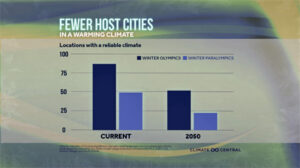
For a few short weeks in February, the entire world gasped together in wonder as Olympic athletes leapt and soared or cringed as one when falls dashed their dreams. But as our alpine regions of the world grow warmer, fewer cities will be able to host the Winter Games.
Notable Video
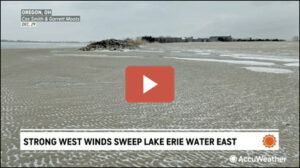
Bombogenesis? Haboobs? Atmospheric lake? Weird terms for weird weather, indeed. Seiche was a new one for us this winter. That’s a standing wave oscillating in a body of water, often caused by extreme wind. In this case, it occurred on Lake Erie, causing a tsunami-like effect. Climate change is making extreme flooding more likely around the Great Lakes, pressuring economies and necessitating protective infrastructure – a reminder that nowhere is safe from the effects of a warming world.